Home→Interview Guides→Data Scientist
Data Scientist Interview Guide
Data Science roles in the Netherlands span two distinct worlds: analytics-heavy roles in fintech and e-commerce (Amsterdam), and applied ML roles in manufacturing and semiconductor companies (Eindhoven). Knowing which world you are applying to is the first step.
Got a vacancy for this role? Get tailored interview prep →
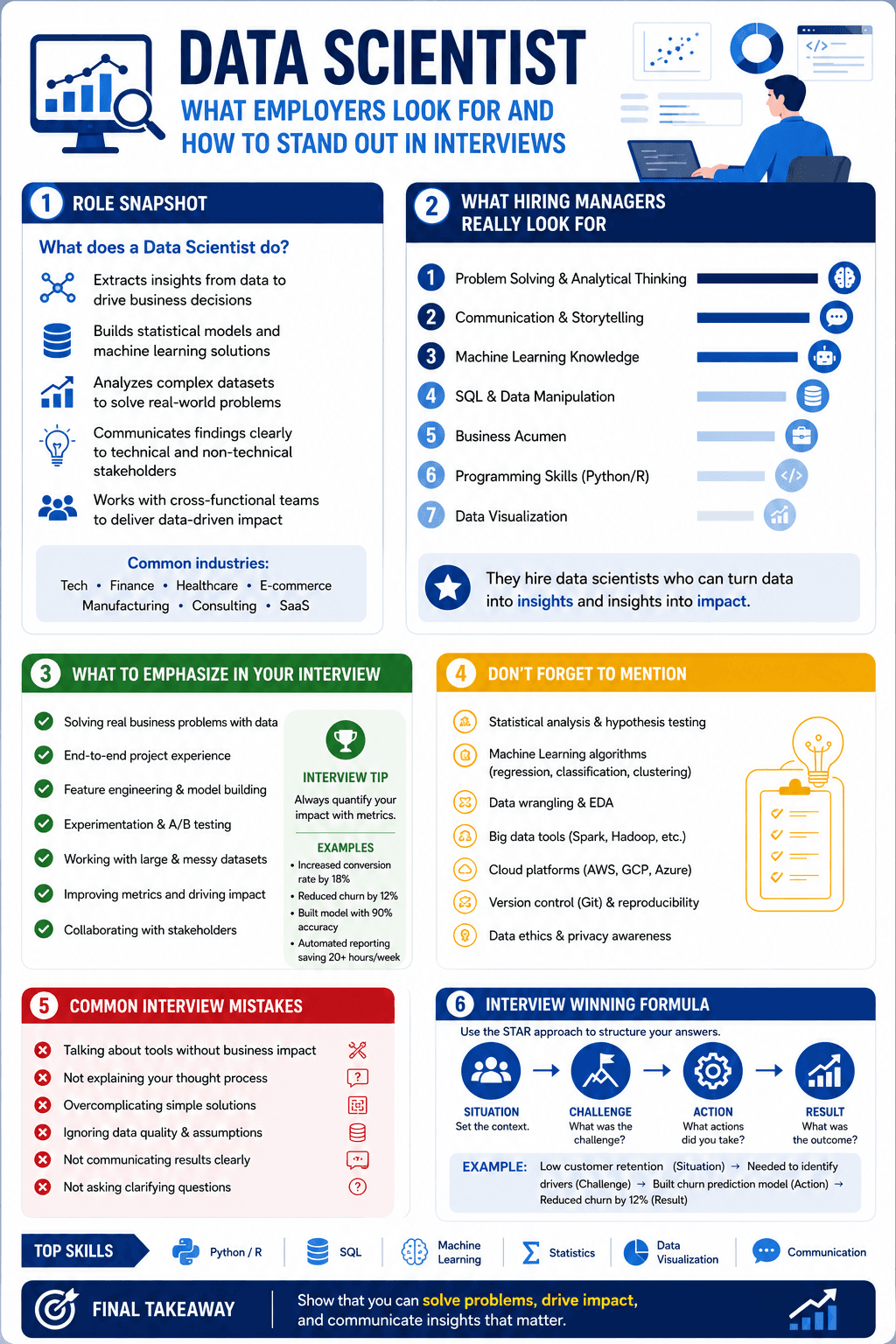
What hiring managers look for
Python fluency with relevant libraries: scikit-learn, PyTorch, TensorFlow, pandas, NumPy
Statistical foundations: regression, classification, clustering, hypothesis testing
Experience deploying models to production — not just Jupyter notebooks
Business impact framing: what business decision did your model inform or improve
SQL proficiency — nearly every data role requires it
For manufacturing/semiconductor: domain knowledge in process optimisation or yield improvement
Top priorities for this role
What hiring managers rank highest when screening Data Scientist candidates.
Business impact — have you shipped models that improved a measurable business outcome?
Production ML experience — notebooks are not models; can you deploy, monitor, and retrain in production?
Statistical rigour — do you know when a result is statistically meaningful and when it is noise?
Domain expertise in the company's sector — a data scientist who understands yield loss is more valuable than a generalist
Communication — can you explain model results to a non-technical stakeholder without losing accuracy?
Don't forget to mention
Statistical analysis and hypothesis testing methods you have applied
ML algorithms by type: regression, classification, clustering — be specific
Data wrangling and exploratory data analysis (EDA)
Big data tools: Spark, Hadoop, or similar at scale
Cloud platforms: AWS, GCP, or Azure at a practitioner level
Version control (Git) and reproducibility practices
Data ethics and privacy awareness — especially relevant under EU law
Common interview mistakes
CVs that are all research with no deployed impact
Omitting the scale of data worked with: rows, frequency, pipeline complexity
Listing accuracy metrics without explaining the baseline or business value
No mention of how models were monitored or maintained after deployment
Likely interview questions
Questions hiring managers commonly ask for Data Scientist roles in the Netherlands. Prepare concrete examples using the STAR method.
Q1
Walk me through a machine learning project you owned end-to-end, from problem definition to production.
Q2
How do you handle class imbalance in a classification problem? What metrics do you use to evaluate the model?
Q3
Explain how you would detect and handle data drift in a production ML model.
Q4
You have a feature with 40% missing values. Walk me through your decision process for handling it.
Q5
Tell me about a time your model performed well in development but poorly in production. What happened?
Tips and tricks
Interview tip
Always quantify your impact with metrics. A result without a number is just a story.
Structure each project as: problem → approach → outcome (with numbers)
Mention any MLOps experience: MLflow, Kubeflow, Weights & Biases
A Kaggle ranking or competition participation is a recognized signal in the Netherlands
For ASML or manufacturing roles, emphasise sensor data, time series, and anomaly detection experience
Interview winning formula
Use the STAR method to structure your answers: Situation → Challenge → Action → Result.
Key skills to include
Tools & technologies
Relevant standards & frameworks
Career progression
Typical growth path for Data Scientists in the high-tech Netherlands ecosystem.
Stage 1
Data Analyst — 0–2 years, descriptive analytics, SQL, dashboards
Stage 2
Data Scientist — 2–5 years, predictive modelling, experiment design, feature engineering
Stage 3
Senior Data Scientist — 5–9 years, owns ML systems in production, drives methodology
Stage 4
Lead / Principal Data Scientist — 9+ years, sets ML strategy, mentors team, cross-company impact
Stage 5
Head of Data / ML Engineering — leadership track into team management or CDO role
Companies in the Brainport region
Deepen your knowledge
Academy topics that hiring managers expect Data Scientists to understand.
See how your CV actually reads
Upload your CV and a vacancy. MyRecruitr reads it like a recruiter would and tells you exactly what to fix.
Analyse my Data Scientist CV →