Home→Interview Guides→Continuous Improvement Engineer
Continuous Improvement Engineer Interview Guide
Continuous Improvement Engineers drive operational excellence across production, quality, and supply chain in the Netherlands. With high-tech and semiconductor companies scaling rapidly, the demand for engineers who can eliminate waste, reduce variation, and build improvements that last — not just run Kaizen events — has grown significantly.
Got a vacancy for this role? Get tailored interview prep →
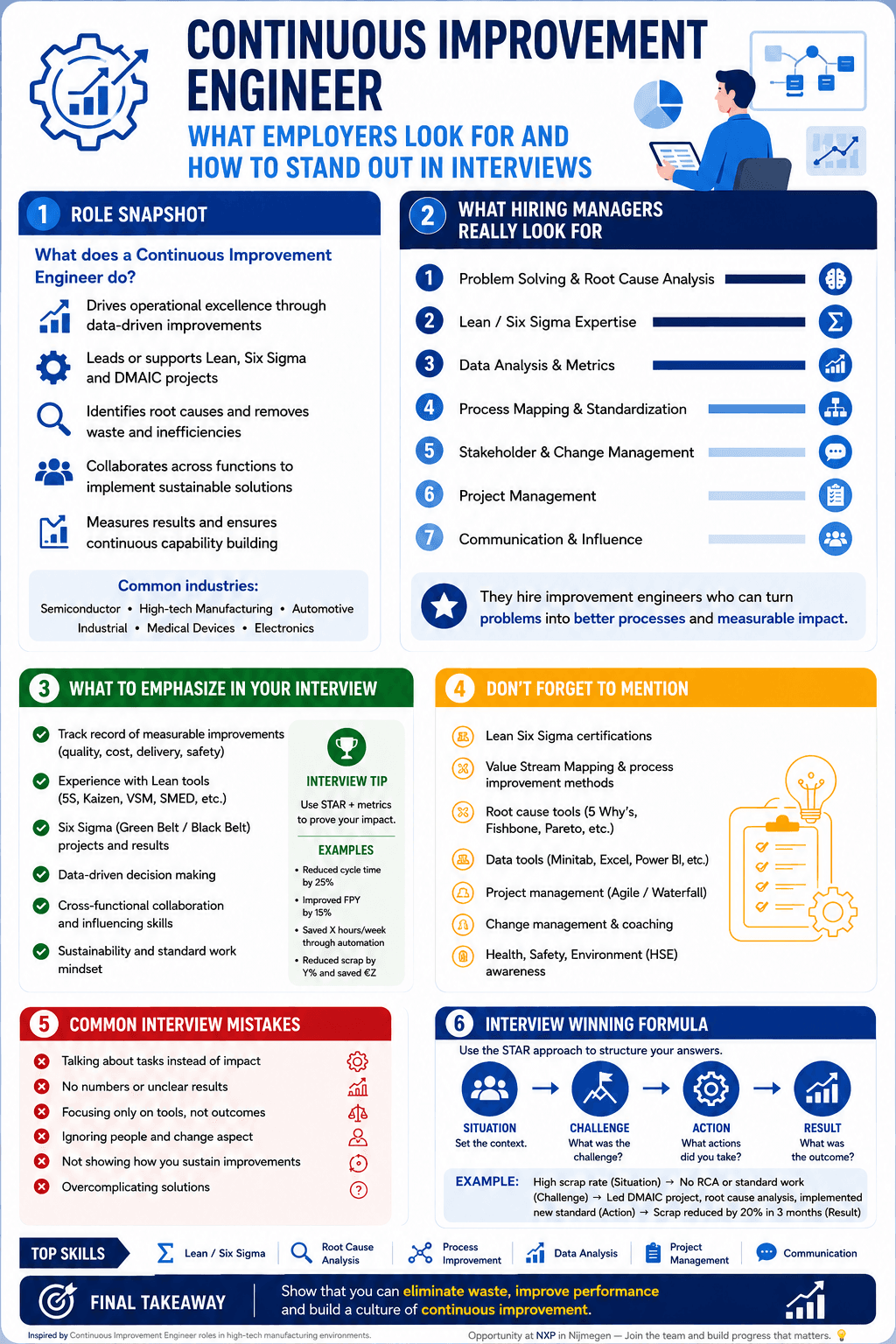
What hiring managers look for
Measurable track record: clear before/after KPIs — OEE, scrap rate, cycle time, cost savings — tied to your specific interventions
Lean and Six Sigma tools: VSM, 5S, Kaizen, SMED, Kanban — applied in real production environments, not just trained on
Root cause analysis methodology: 5 Whys, Fishbone, FMEA — leading analyses independently, not just participating
Data analysis: Minitab, Excel, Power BI — using statistics to validate hypotheses and measure improvement, not just report metrics
Process mapping and standardisation: documenting current state, designing future state, and driving adoption across shifts
Stakeholder and change management: cross-functional influence without authority, navigating resistance to change
Project management: running multiple improvement projects simultaneously with clear ownership and timelines
Top priorities for this role
What hiring managers rank highest when screening Continuous Improvement Engineer candidates.
Results orientation — can you quantify the savings, quality improvements, or productivity gains from your projects?
Change management skills — CI engineers change how people work; technical skill without influence skill is useless
Statistical competence — do you analyse data or do you analyse feelings?
Lean/Six Sigma tools depth — knowing the tools is table stakes; applying them in a way that sustains beyond the project is what counts
Cross-functional facilitation — kaizen events, VSM workshops, and problem-solving sessions require strong group facilitation
Don't forget to mention
Lean Six Sigma certifications and the belt level you hold
Value Stream Mapping experience — and whether you mapped a full end-to-end process or a single area
Root cause tools: 5 Whys, Fishbone, Pareto — and what you actually found using them
Data tools you use day-to-day: Minitab, Excel, Power BI
Project management approach: Agile sprints, A3 problem solving, or formal project charters
Management and coaching: have you trained operators or team leads in CI methods?
Health, Safety, and Environment (HSE) awareness in a production context
Common interview mistakes
Describing activities ("I ran a Kaizen event") without stating the outcome — the before/after metric is what matters
No numbers or unclear results — vague improvement claims are dismissed by managers who measure everything
Focusing only on tools without showing the people and change management side
Not demonstrating sustained results: implementing an improvement and leaving it running for 6 months is the real proof
Overcomplicating solutions — CI engineers are often valued for simplicity and pragmatism, not technical sophistication
Not showing that you coach or transfer capability — CI is about building a culture, not being the only one who can improve
Likely interview questions
Questions hiring managers commonly ask for Continuous Improvement Engineer roles in the Netherlands. Prepare concrete examples using the STAR method.
Q1
Describe your most impactful continuous improvement project. What was the problem, your approach, and the measurable outcome?
Q2
Walk me through how you would run a value stream mapping exercise for a new product line.
Q3
How do you sustain process improvements after the initial project is complete?
Q4
Tell me about a time when resistance from operators or managers threatened a CI initiative. How did you handle it?
Q5
How do you prioritise which improvement projects to pursue when there are more opportunities than resources?
Tips and tricks
Interview tip
Use the STAR method to prove your impact. Numbers are your credibility — every improvement you drove has one.
Every CI role on your CV must have at least one quantified outcome — work backwards from memory if you have to
Show the full improvement cycle: problem → root cause → solution → implementation → sustained result
Green or Black Belt certification matters — but pair it with real project outcomes, not just the credential
Give an example of driving change when people pushed back — this separates good CI engineers from great ones
In high-tech, VSM of complex multi-step engineering processes is rare and valued — call it out if you have done it
Interview winning formula
Use the STAR method to structure your answers: Situation → Challenge → Action → Result.
Key skills to include
Tools & technologies
Relevant standards & frameworks
Career progression
Typical growth path for Continuous Improvement Engineers in the high-tech Netherlands ecosystem.
Stage 1
CI Engineer / Lean Coordinator — 0–3 years, facilitates kaizen events and supports CI projects
Stage 2
Senior CI Engineer / Green Belt — 3–6 years, leads Six Sigma and lean programmes
Stage 3
CI Manager / Black Belt — 6–10 years, manages CI portfolio, coaches Green Belts
Stage 4
Head of Continuous Improvement / MBB — 10+ years, drives operational excellence strategy
Stage 5
VP Operations / COO track — CI expertise leading to operational leadership
Companies in the Brainport region
Deepen your knowledge
Academy topics that hiring managers expect Continuous Improvement Engineers to understand.
See how your CV actually reads
Upload your CV and a vacancy. MyRecruitr reads it like a recruiter would and tells you exactly what to fix.
Analyse my Continuous Improvement Engineer CV →