Home→Interview Guides→Mechanical Engineer
Mechanical Engineer Interview Guide
Mechanical Engineers in the Netherlands high-tech sector face uniquely demanding requirements. Whether designing precision components for ASML's lithography systems or developing robust enclosures for Philips medical devices, the bar for design quality is exceptionally high. Companies look for engineers who move from concept through production, grounded in DFM and backed by quantified results.
Got a vacancy for this role? Get tailored interview prep →
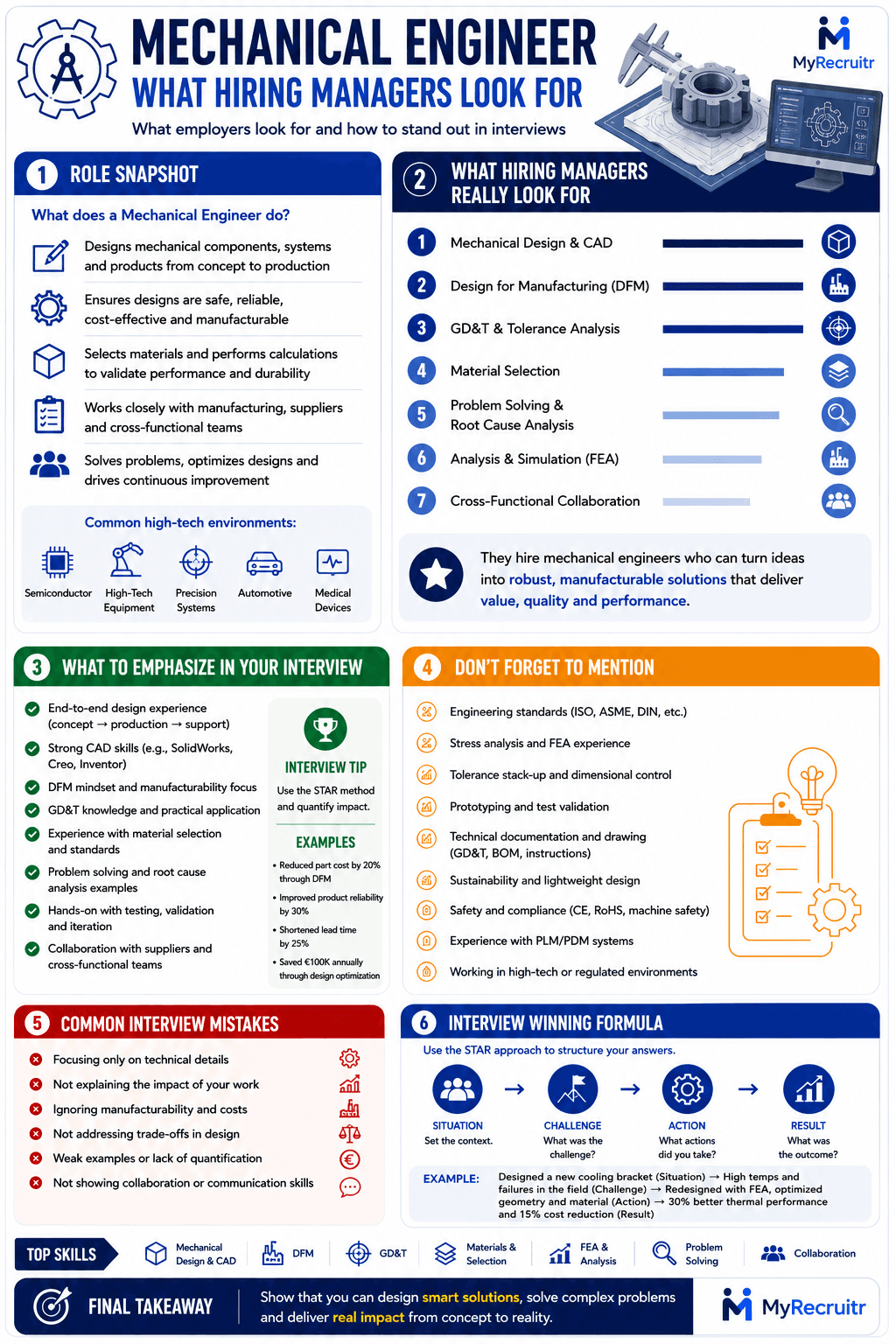
What hiring managers look for
Mechanical design proficiency: SolidWorks, Creo, CATIA or NX — with end-to-end ownership from concept to production drawing
Design for Manufacturing (DFM): demonstrable awareness of how your designs impact machining, assembly cost, and lead time
GD&T and tolerance analysis: tolerance stack-ups linked to functional requirements — not just drawing callouts
Material selection: metals, polymers, composites — with reasoning based on function, environment, and cost
FEA and simulation: ANSYS, Abaqus, or SolidWorks Simulation with correlation to physical test results
Root cause analysis: structured problem solving for field failures, production issues, or design deficiencies
Cross-functional collaboration: working with manufacturing, suppliers, and test teams across the full product lifecycle
Top priorities for this role
What hiring managers rank highest when screening Mechanical Engineer candidates.
Design for manufacturing and assembly (DFM/DFA) — do you design with manufacturing constraints in mind from day one?
Analysis capability — FEA, thermal analysis, tolerance stack-up; can you prove your design works before building it?
Materials selection judgement — choosing the right material for the operating environment shows engineering maturity
Drawing and communication skills — can you produce clear, GD&T-correct drawings that a machinist can work from?
Hands-on build and test experience — engineers who have seen their designs fail in the lab learn faster
Don't forget to mention
Engineering standards you have worked under: ISO, ASME, DIN, CE marking
Stress analysis and FEA — and whether your simulation matched the physical test
Tolerance stack-up and dimensional control experience
Prototyping and test validation — from design to build to result
Technical documentation: GD&T drawings, BOMs, assembly instructions
Sustainability and lightweight design considerations
Safety and compliance: CE, RoHS, machine safety directives
Common interview mistakes
Focusing only on what you designed without stating the engineering challenge it solved
Not explaining the impact on cost, reliability, or lead time — design outcomes matter as much as design intent
Ignoring manufacturability: a design that creates production problems signals a gap in engineering maturity
Not addressing trade-offs: good mechanical engineering is a set of deliberate compromises — show you understand this
Weak or absent quantification: "robust design" and "improved performance" are meaningless without numbers
No mention of collaboration with suppliers or production — mechanical design does not happen in isolation
Likely interview questions
Questions hiring managers commonly ask for Mechanical Engineer roles in the Netherlands. Prepare concrete examples using the STAR method.
Q1
Walk me through a mechanical design project from requirements to validated hardware. What choices did you make and why?
Q2
How do you perform a tolerance stack-up analysis? When would you use worst-case versus statistical (RSS) analysis?
Q3
Describe a time when your design failed during testing. How did you diagnose and fix it?
Q4
How do you approach material selection for a part that must survive a harsh chemical and thermal environment?
Q5
What is GD&T and why is it preferable to coordinate tolerancing for critical assembly features?
Tips and tricks
Interview tip
Use the STAR method and quantify impact. Every design decision had a consequence — name the one you are most proud of.
Open every design role with the product it belongs to: what system, what environment, what the performance target was
Lead with DFM awareness: designs that survived production without rework signal engineering maturity to a hiring manager
Show a tolerance stack-up example — tight fits, thermal expansion, or assembly variation with real numbers
Pair every design claim with a result: cost-per-part reduction, weight saving, reliability improvement, or lead time reduction
If you have defended a design in a formal design review (PDR, CDR), name it — it signals experience in structured development
Interview winning formula
Use the STAR method to structure your answers: Situation → Challenge → Action → Result.
Key skills to include
Tools & technologies
Relevant standards & frameworks
Career progression
Typical growth path for Mechanical Engineers in the high-tech Netherlands ecosystem.
Stage 1
Junior Mechanical Engineer — 0–3 years, designs parts under guidance, supports prototype builds
Stage 2
Mechanical Engineer — 3–6 years, owns mechanical subassembly design and qualification
Stage 3
Senior Mechanical Engineer — 6–10 years, leads mechanical architecture for new products
Stage 4
Principal / Lead Mechanical Engineer — 10+ years, defines mechanical design standards and platform strategy
Stage 5
Chief Mechanical Engineer / Technical Director — executive engineering leadership
Companies in the Brainport region
Deepen your knowledge
Academy topics that hiring managers expect Mechanical Engineers to understand.
See how your CV actually reads
Upload your CV and a vacancy. MyRecruitr reads it like a recruiter would and tells you exactly what to fix.
Analyse my Mechanical Engineer CV →