Home→Interview Guides→DevOps Engineer
DevOps Engineer Interview Guide
DevOps Engineering in the Netherlands is evolving fast. Beyond the classic CI/CD pipeline role, companies now expect platform engineering skills, cloud-native expertise, and increasingly, security awareness (DevSecOps). The bar has risen.
Got a vacancy for this role? Get tailored interview prep →
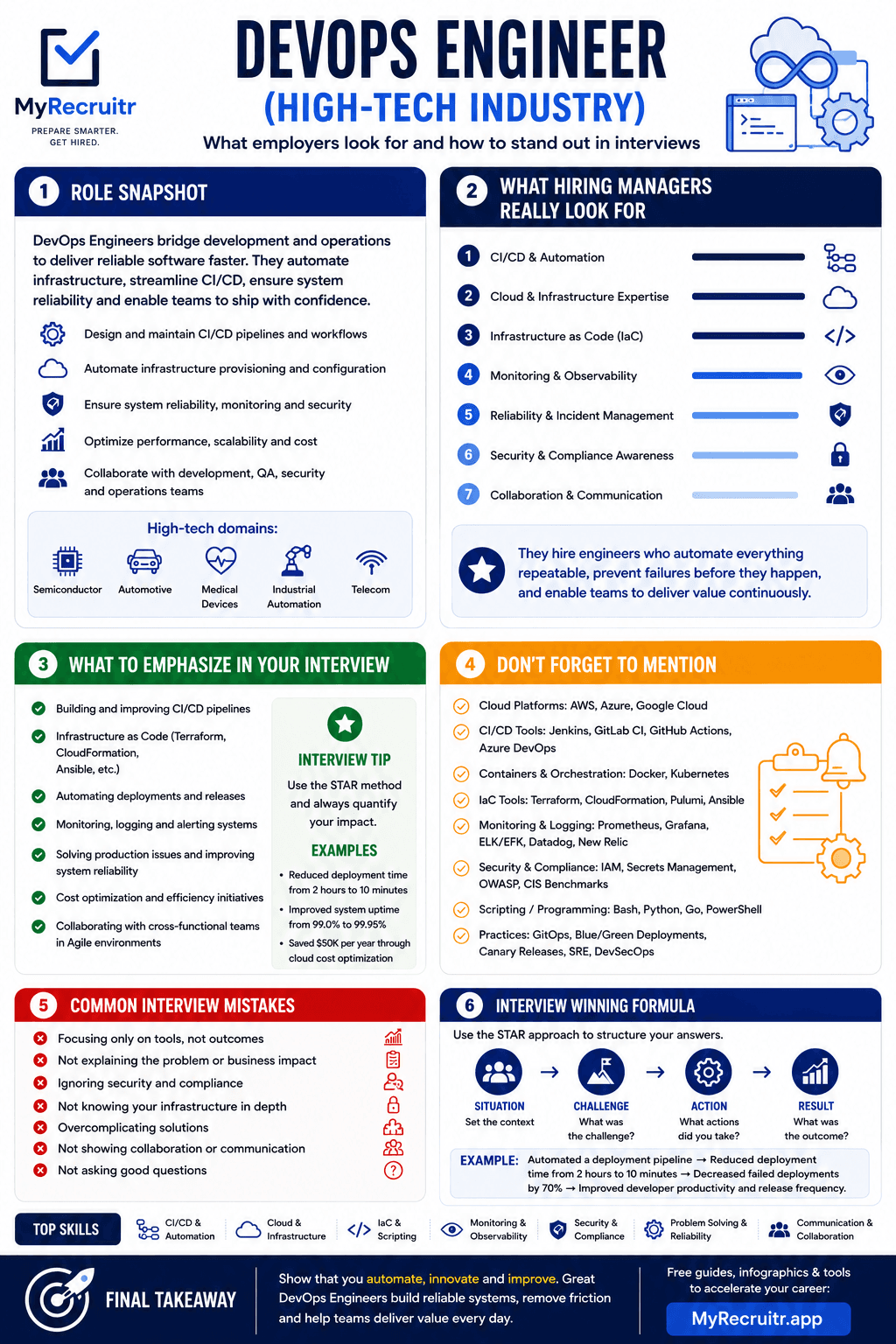
What hiring managers look for
Container orchestration: Kubernetes at a practitioner level (CKAD/CKA certification is a strong signal)
Infrastructure as Code: Terraform, Pulumi, or CloudFormation
CI/CD pipeline experience: GitHub Actions, GitLab CI, Jenkins, or Azure Pipelines
Cloud platform depth: pick one and go deep — AWS, Azure, or GCP
Monitoring and observability: Prometheus, Grafana, Datadog, or similar
Security mindset: secrets management, RBAC, network policies
Top priorities for this role
What hiring managers rank highest when screening DevOps Engineer candidates.
Infrastructure as Code in practice — have you actually built and maintained Terraform / Ansible at scale?
Incident response experience — how do you behave when production is down at 2am?
Security integration — is security an afterthought or part of your pipeline design?
Developer empathy — do you build platforms that developers want to use, or that they route around?
Cost awareness — cloud bills are a real engineering constraint; do you optimise?
Common interview mistakes
Listing every tool you have touched without indicating depth
No metrics: deployment frequency, MTTR, incident reduction, uptime improvement
Ignoring the developer experience aspect — modern DevOps is also about making developers productive
No mention of on-call experience or incident management for roles that require it
Likely interview questions
Questions hiring managers commonly ask for DevOps Engineer roles in the Netherlands. Prepare concrete examples using the STAR method.
Q1
Walk me through how you would design a CI/CD pipeline for a microservices application deploying to Kubernetes.
Q2
Describe the worst production incident you have been involved in. What was your role, and what changed afterwards?
Q3
How do you handle secrets management in a Kubernetes environment?
Q4
What is your strategy for zero-downtime deployments? When would you use blue/green vs. canary vs. rolling updates?
Q5
A developer says "it works on my machine." Walk me through how you would investigate and solve this problem systematically.
Tips and tricks
Certifications matter more in DevOps than in most engineering disciplines — list them prominently
Frame your work as enabling others: "reduced deployment time from 4 hours to 12 minutes"
Show progression from manual to automated: it demonstrates initiative
Dutch employers value pragmatism — show that you ship, not just that you architect
Key skills to include
Tools & technologies
Relevant standards & frameworks
Career progression
Typical growth path for DevOps Engineers in the high-tech Netherlands ecosystem.
Stage 1
Junior DevOps Engineer — 0–2 years, maintains existing pipelines, basic CI/CD work
Stage 2
DevOps Engineer — 2–5 years, designs and implements CI/CD, manages cloud infrastructure
Stage 3
Senior DevOps / Platform Engineer — 5–9 years, designs developer platforms, defines standards
Stage 4
Principal DevOps Engineer / SRE — 9+ years, cross-organisation reliability and architecture
Stage 5
Head of Platform Engineering / VP Infrastructure — leadership track
Companies in the Brainport region
Deepen your knowledge
Academy topics that hiring managers expect DevOps Engineers to understand.
See how your CV actually reads
Upload your CV and a vacancy. MyRecruitr reads it like a recruiter would and tells you exactly what to fix.
Analyse my DevOps Engineer CV →