Home→Interview Guides→Systems Engineer
Systems Engineer Interview Guide
Systems Engineers sit at the intersection of hardware, software, and stakeholder management. In companies like ASML — which builds some of the world's most complex machines — the systems engineer role is critical and highly competitive.
Got a vacancy for this role? Get tailored interview prep →
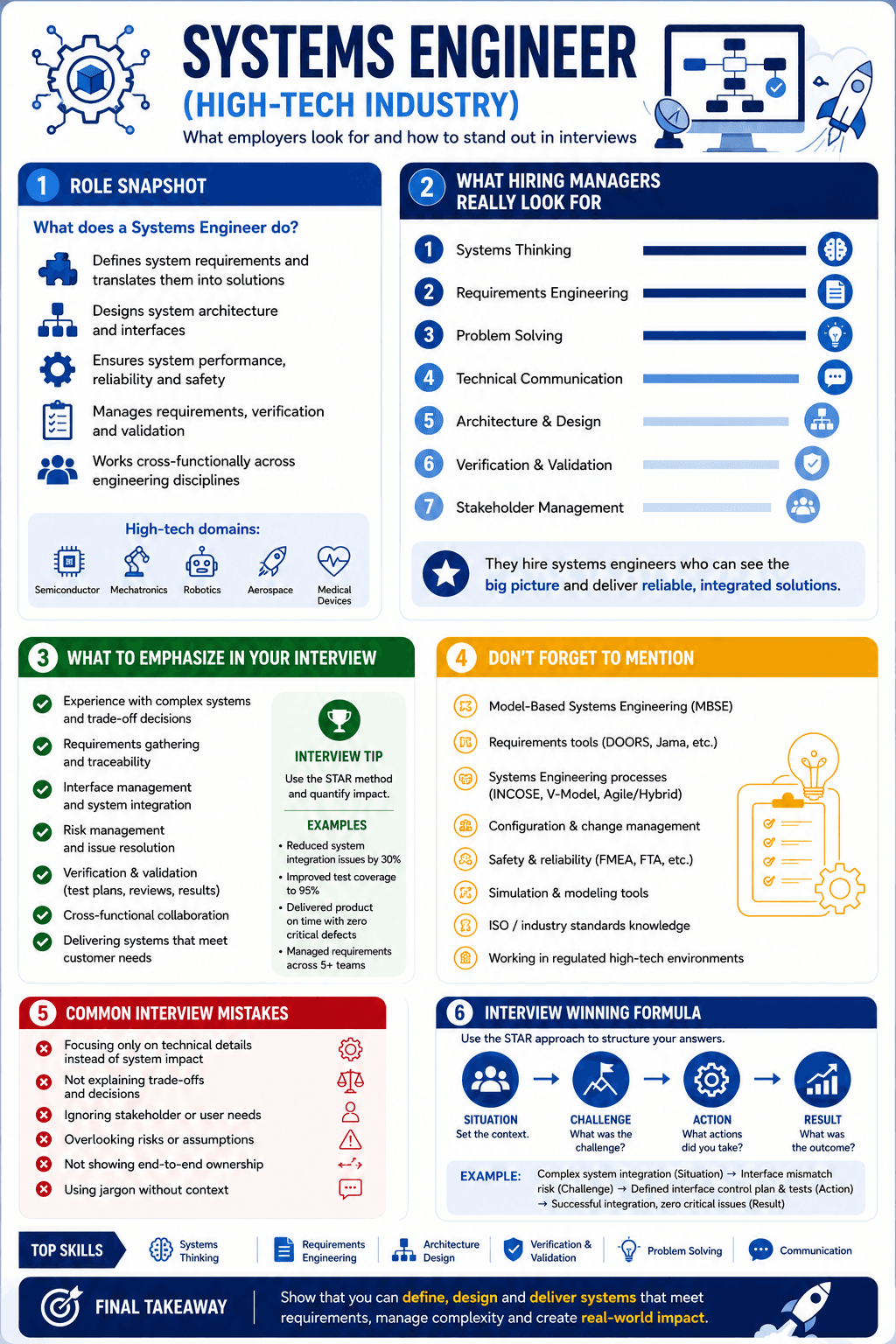
What hiring managers look for
Experience with model-based systems engineering (MBSE) using tools like SysML, Capella, or Cameo
Requirements engineering: writing, decomposing, and verifying system requirements
Interface Control Documents (ICDs) and interface management experience
V-model development lifecycle and verification & validation (V&V) methodology
Cross-disciplinary communication skills — systems engineers bridge mechanical, electrical, and software teams
Experience in high-tech or mechatronic systems (semiconductor equipment, medical devices, aerospace)
Top priorities for this role
What hiring managers rank highest when screening Systems Engineer candidates.
Ability to manage complexity across multiple engineering disciplines simultaneously
Requirements traceability — can you show a requirement from stakeholder need through design to test?
Interface management experience — defining and controlling what crosses the boundary between subsystems
Communication with non-engineers — systems engineers must translate between technical and business stakeholders
Comfort with ambiguity — requirements are always incomplete; how do you handle that?
Don't forget to mention
Model-Based Systems Engineering (MBSE) and the specific tools you used
Systems Engineering processes you have worked within: INCOSE, V-Model, Agile/Hybrid
Configuration and change management experience
Safety and reliability analysis: FMEA, FTA, and similar techniques
Simulation and modelling tools relevant to your domain
ISO or industry standards you have worked under
Experience in regulated high-tech environments (semiconductor, aerospace, medical)
Common interview mistakes
Focusing only on technical depth without showing cross-functional coordination
Not naming the specific tools used for requirements management (DOORS, Polarion, Jama)
No evidence of system-level thinking — describing subsystem work without showing the bigger picture
Missing complexity indicators: number of interfaces managed, system size, certification level
Likely interview questions
Questions hiring managers commonly ask for Systems Engineer roles in the Netherlands. Prepare concrete examples using the STAR method.
Q1
Walk me through how you decompose a system-level requirement into subsystem requirements. What process do you follow?
Q2
Describe a time when you identified an interface conflict between two subsystems. How did you resolve it?
Q3
How do you decide when a system is ready for integration testing?
Q4
What is the difference between verification and validation, and why does the distinction matter?
Q5
How do you manage requirements changes late in a development programme without destabilising the design?
Tips and tricks
Interview tip
Use the STAR method and quantify impact. Numbers make your answers memorable and credible.
Show both breadth and depth: mention the full system you contributed to before zooming into your specific work
Highlight any experience with functional safety standards relevant to your domain
If you have led or participated in design reviews (PDR, CDR), name them explicitly
ASML specifically values candidates with lithography or semiconductor process knowledge — mention any relevant domain experience
Interview winning formula
Use the STAR method to structure your answers: Situation → Challenge → Action → Result.
Key skills to include
Tools & technologies
Relevant standards & frameworks
Career progression
Typical growth path for Systems Engineers in the high-tech Netherlands ecosystem.
Stage 1
Systems Engineer — 0–5 years, owns specific system functions and interface documents
Stage 2
Senior Systems Engineer — 5–10 years, leads design and V&V for a major subsystem
Stage 3
Lead Systems Engineer / Architect — 10+ years, defines system architecture for new programmes
Stage 4
Chief Engineer / System Architect — technical authority for a full product family
Stage 5
Engineering Director — transitions into programme-level or business leadership
Companies in the Brainport region
Deepen your knowledge
Academy topics that hiring managers expect Systems Engineers to understand.
See how your CV actually reads
Upload your CV and a vacancy. MyRecruitr reads it like a recruiter would and tells you exactly what to fix.
Analyse my Systems Engineer CV →