Home→Interview Guides→Industrialization Engineer
Industrialization Engineer Interview Guide
Industrialization Engineers turn a design that works once in a lab into a process that works every time at volume. Where an NPI Engineer typically owns the cross-functional coordination of a launch, the Industrialization Engineer owns the harder technical problem underneath it: developing, optimising, and validating the process itself — equipment, work instructions, and process windows — so that yield, cost, and cycle time all land where the business needs them. In the Netherlands high-tech sector this work sits at the centre of every successful ramp-up, and recruiters look for engineers who can show a process they built, not just a launch they supported.
Got a vacancy for this role? Get tailored interview prep →
What hiring managers look for
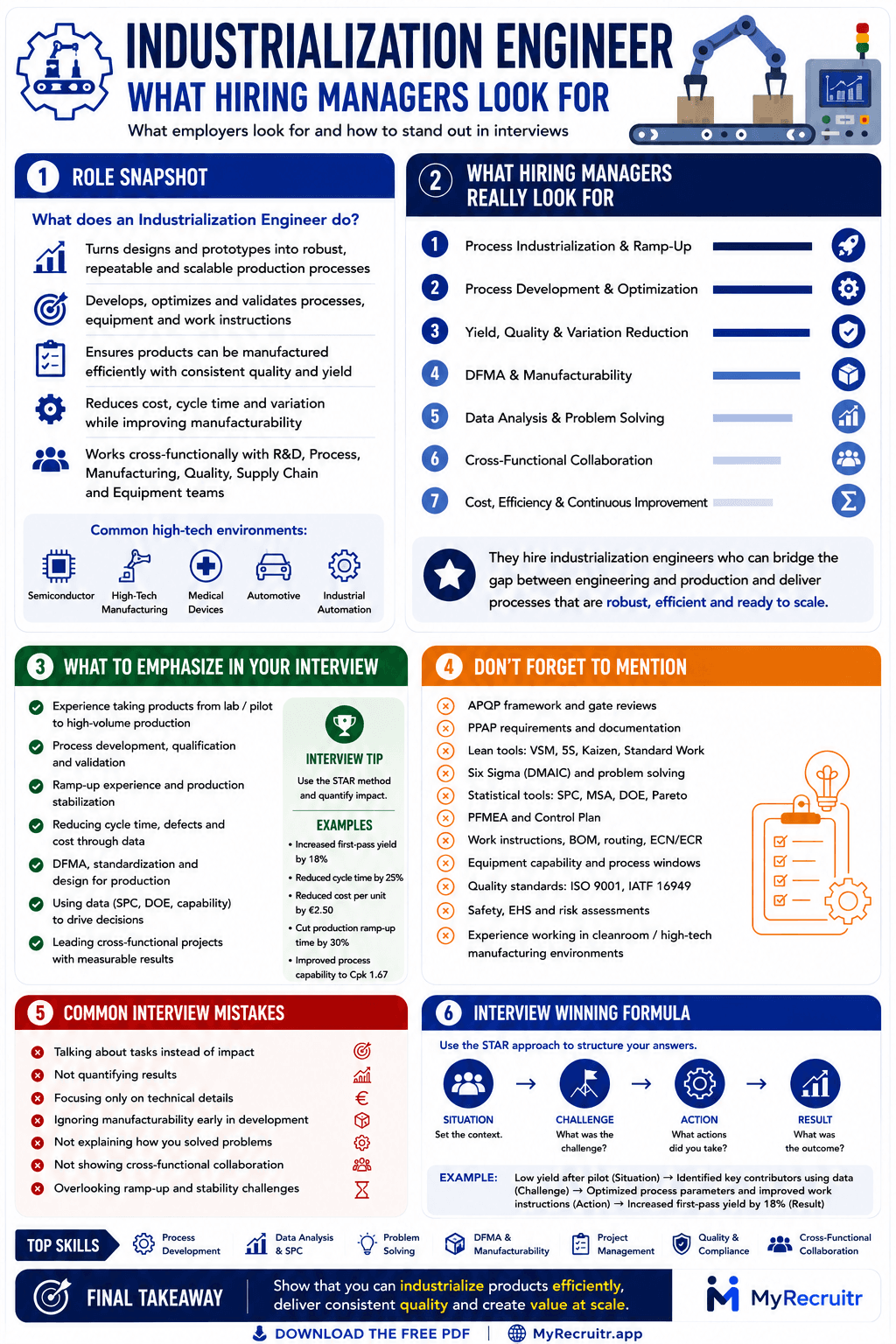
Process industrialisation and ramp-up: taking a process from lab or pilot scale to stable, repeatable high-volume production
Process development and optimisation: tuning process parameters using data, not trial and error, to hit yield and cost targets
Yield, quality, and variation reduction: a track record of measurably improving first-pass yield or reducing process variation
DFMA and manufacturability: influencing designs for manufacturability and assembly before they reach production, not after
Data analysis and problem solving: fluency with SPC, DOE, and capability studies (Cp/Cpk) applied to real process data
Cross-functional collaboration: working across R&D, Process, Manufacturing, Quality, Supply Chain, and Equipment to industrialise a process others depend on
Top priorities for this role
What hiring managers rank highest when screening Industrialization Engineer candidates.
Process ownership at the technical level — can you show a process window or parameter set you personally developed and validated?
Statistical rigour — SPC, DOE, and capability analysis used to make real process decisions, not just reported after the fact
DFMA input early in development — the best industrialisation engineers shape a design before tooling is committed, not after
Ramp-up resilience — a process that yields well once is different from one that holds yield for months; which have you actually delivered?
Cross-functional technical credibility — R&D, Manufacturing, and Quality all need to trust your process data enough to commit to it
Don't forget to mention
APQP framework experience and the gate reviews you were accountable for
PPAP requirements and documentation you prepared or reviewed
Lean tools by name: VSM, 5S, Kaizen, Standard Work — and a project where you applied them
Six Sigma / DMAIC problem solving, and your belt level if applicable
Statistical tools: SPC, MSA, DOE, Pareto — and how you used them to drive a process decision
PFMEA and Control Plan ownership for a process you industrialised
Work instructions, BOM, routing, and ECN/ECR experience — the documentation that makes a process repeatable
Common interview mistakes
Talking about tasks completed rather than the process performance impact they had
Not quantifying results — yield, cycle time, and cost per unit are the metrics this role is judged on
Focusing only on technical process detail without explaining the business impact
Ignoring manufacturability early in development — DFMA input that arrives after tooling is committed is far less valuable
Not explaining how a process problem was actually solved — hiring managers want the data path from symptom to fix
Overlooking ramp-up and stability challenges — a process that yields well once is different from one that yields well for months
Likely interview questions
Questions hiring managers commonly ask for Industrialization Engineer roles in the Netherlands. Prepare concrete examples using the STAR method.
Q1
Walk me through a process you industrialised from pilot to volume. What was the yield trajectory, and what drove the biggest improvement?
Q2
How do you use DOE to identify which process parameters actually matter versus which ones are noise?
Q3
Describe a DFMA change you influenced during design. What was the manufacturability problem, and what did the change save?
Q4
How do you know when a process is ready to move from pilot to volume production?
Q5
Tell me about a ramp-up where yield dropped after an initially successful pilot. What was different, and how did you fix it?
Tips and tricks
Interview tip
Use the STAR method and quantify impact. Hiring managers want the data behind your process decision — what you measured, what you changed, and the yield or cost number that followed.
Use the STAR method and quantify impact: first-pass yield gains, cycle time reduction, cost per unit, or Cpk improvement
Describe the scale of the process you industrialised: what product, what volume target, what timeline from pilot to volume
Show your statistical fluency explicitly: SPC, DOE, and capability studies tied to a real process decision you made
Name your DFMA involvement — what you changed in a design before production, and what it saved downstream
If you led a cross-functional industrialisation project, describe how you got R&D, Manufacturing, and Quality aligned on a single process approach
Interview winning formula
Use the STAR method to structure your answers: Situation → Challenge → Action → Result.
Key skills to include
Tools & technologies
Relevant standards & frameworks
Career progression
Typical growth path for Industrialization Engineers in the high-tech Netherlands ecosystem.
Stage 1
Industrialization Engineer I — 0–3 years, supports process development and validation under guidance
Stage 2
Industrialization Engineer II — 3–6 years, owns process industrialisation for a product independently
Stage 3
Senior Industrialization Engineer — 6–10 years, leads process strategy across multiple concurrent industrialisation projects
Stage 4
Principal Industrialization Engineer — 10+ years, defines industrialisation methodology and standards across a site
Stage 5
Director of Manufacturing Engineering — leadership track into broader manufacturing engineering ownership
Companies in the Brainport region
Deepen your knowledge
Academy topics that hiring managers expect Industrialization Engineers to understand.
See how your CV actually reads
Upload your CV and a vacancy. MyRecruitr reads it like a recruiter would and tells you exactly what to fix.
Analyse my Industrialization Engineer CV →