Home→Interview Guides→Embedded Software Engineer
Embedded Software Engineer Interview Guide
Embedded Software Engineers are among the most in-demand professionals in the Brainport region. Companies like ASML, NXP, and Philips are constantly hiring — but their recruitment bar is high and the CVs they receive are often poorly structured for the role.
Got a vacancy for this role? Get tailored interview prep →
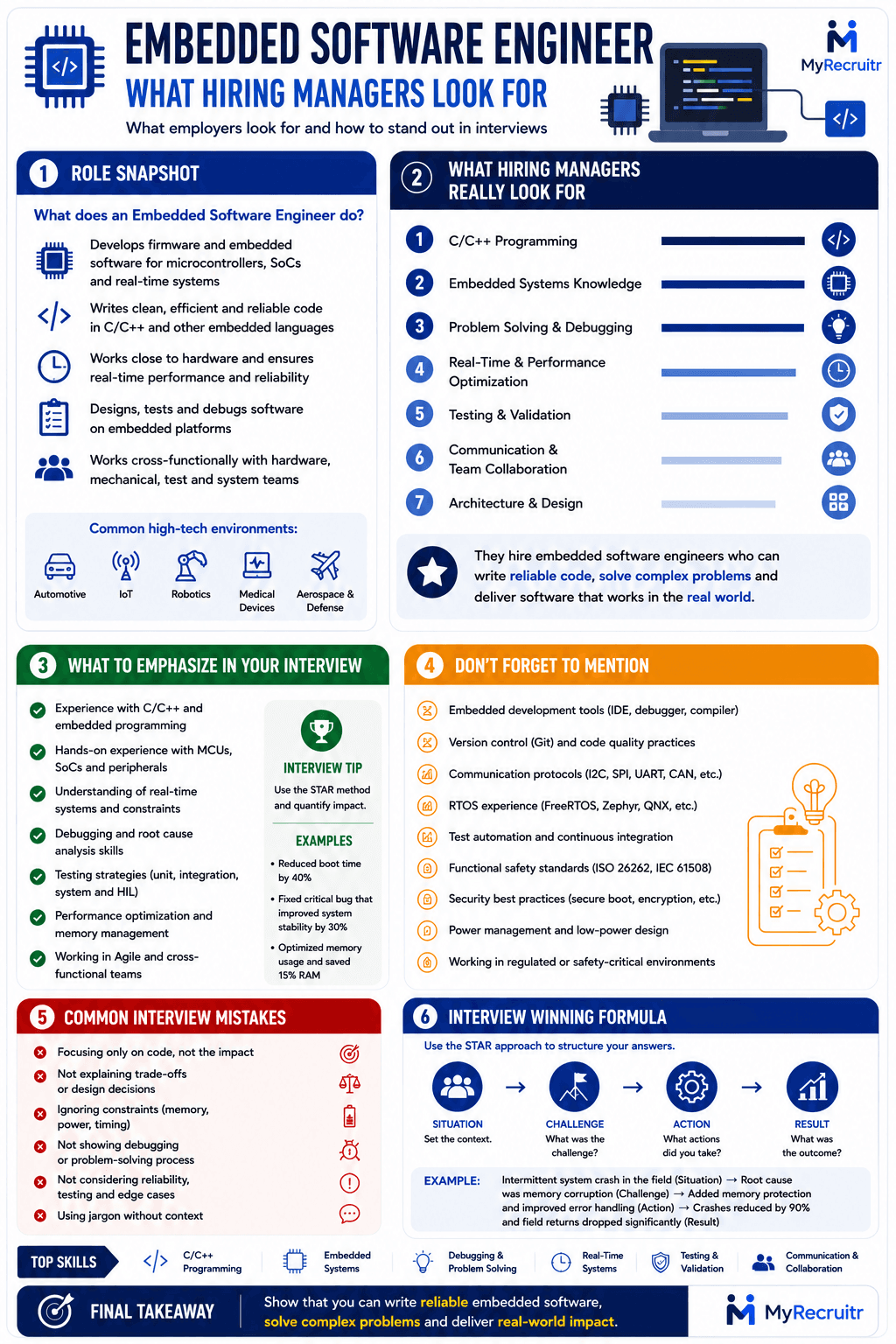
What hiring managers look for
Demonstrable experience with real-time operating systems (RTOS) such as FreeRTOS, VxWorks, or QNX
C and C++ proficiency — list the version standards you have worked with (C++11/14/17)
Hardware/software interface experience: SPI, I2C, UART, CAN, PCIe
Evidence of working in safety-critical or high-reliability environments (ISO 26262, IEC 61508, DO-178C)
Familiarity with debugging tools: JTAG, oscilloscopes, logic analysers
Experience with version control (Git) and CI/CD in embedded contexts
Top priorities for this role
What hiring managers rank highest when screening Embedded Software Engineer candidates.
Real hardware experience — have you actually debugged on target silicon, not just in simulation?
Understanding of the full embedded stack: from bare metal to RTOS to application layer
Safety and reliability mindset — critical in ASML and medical device contexts where a software fault stops production
Ownership and problem-solving ability — can you diagnose a race condition at 3am without help?
Communication with hardware and mechanical teams — embedded engineers do not work in isolation
Don't forget to mention
Embedded development tools: IDE, debugger, compiler — name the specific toolchain
Version control (Git) and code quality practices (code review, static analysis)
Communication protocols you have implemented at driver level: I2C, SPI, UART, CAN
RTOS experience: FreeRTOS, Zephyr, QNX — and the scheduling and synchronisation patterns you used
Test automation and continuous integration in an embedded context
Functional safety standards if applicable: ISO 26262, IEC 61508
Security practices: secure boot, encryption, memory protection units (MPU)
Power management and low-power design techniques
Common interview mistakes
Listing languages without context — "C++" on its own tells a recruiter nothing; specify what you built
No mention of the target hardware (MCU/MPU families: ARM Cortex, STM32, NXP i.MX)
Burying the most relevant experience at the bottom of the CV
Missing keywords that ATS systems filter on: "bare-metal", "firmware", "BSP", "device driver"
Omitting team size and project scale — recruiters want to know if you worked solo or in a 50-person organisation
Likely interview questions
Questions hiring managers commonly ask for Embedded Software Engineer roles in the Netherlands. Prepare concrete examples using the STAR method.
Q1
Walk me through how you debug a race condition in a real-time embedded system. What tools do you use?
Q2
Explain the difference between a hard real-time and soft real-time system. Give an example of each from your experience.
Q3
How do you handle memory management in a system without dynamic allocation? Why would you avoid malloc in an embedded system?
Q4
Describe a time when a hardware bug looked like a software bug. How did you identify and resolve it?
Q5
How do you ensure your firmware is safe to update in the field? What is your approach to OTA updates?
Tips and tricks
Interview tip
Use the STAR method and quantify impact. Numbers make your answers memorable and credible.
Lead with your most impressive embedded project in the first bullet of each role
Quantify impact where possible: "reduced boot time by 40%", "achieved 99.97% uptime over 18 months"
Tailor the skills section to the specific vacancy — pull keywords directly from the job description
If you have safety certification experience, put it in a dedicated section near the top
A GitHub link with real embedded projects (even personal ones) significantly increases callback rate
Interview winning formula
Use the STAR method to structure your answers: Situation → Challenge → Action → Result.
Key skills to include
Tools & technologies
Relevant standards & frameworks
Career progression
Typical growth path for Embedded Software Engineers in the high-tech Netherlands ecosystem.
Stage 1
Junior Embedded Software Engineer — 0–3 years, owns individual features under supervision
Stage 2
Embedded Software Engineer — 3–6 years, leads features, reviews peers, owns a subsystem
Stage 3
Senior Embedded Software Engineer — 6–10 years, designs software architecture for new platforms
Stage 4
Principal / Staff Engineer — 10+ years, technical authority across multiple products or programmes
Stage 5
Engineering Manager or Architect — leadership track into management or system-level design
Companies in the Brainport region
Deepen your knowledge
Academy topics that hiring managers expect Embedded Software Engineers to understand.
See how your CV actually reads
Upload your CV and a vacancy. MyRecruitr reads it like a recruiter would and tells you exactly what to fix.
Analyse my Embedded Software Engineer CV →