Home→Interview Guides→Manufacturing Engineer
Manufacturing Engineer Interview Guide
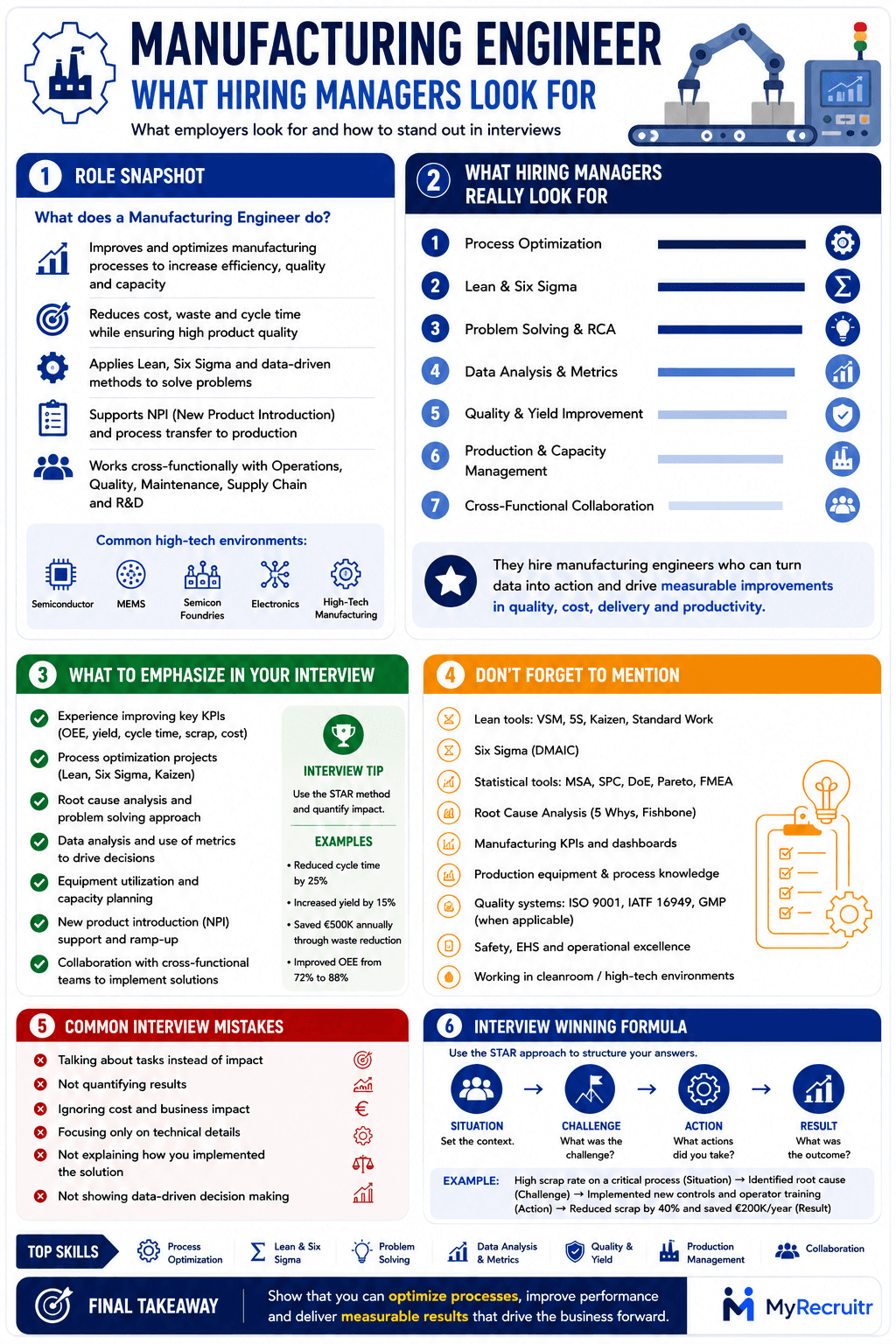
Manufacturing Engineers are the backbone of production in the Netherlands high-tech and semiconductor sector. With TSMC's planned expansion and established players like NXP and Philips scaling up, the demand for engineers who can optimise processes, implement Lean methodologies, and drive measurable yield improvements has never been higher.
Got a vacancy for this role? Get tailored interview prep →
What hiring managers look for
Process optimisation experience: OEE, cycle time, yield and scrap improvements — always with before/after numbers
Lean and Six Sigma methodology: VSM, 5S, Kaizen, DMAIC — hands-on project ownership, not just classroom awareness
Root cause analysis: structured problem solving using 5 Whys, Fishbone, and FMEA in a real production environment
Data analysis and metrics: SPC, DoE, MSA — using data to drive and validate decisions, not just report them
Quality and yield improvement: experience working with quality teams to drive measurable output and defect reduction
NPI support and ramp-up: ability to transfer a process from development into volume production
Cross-functional collaboration: working across engineering, quality, supply chain, and operations simultaneously
Top priorities for this role
What hiring managers rank highest when screening Manufacturing Engineer candidates.
Process ownership mentality — do you take responsibility for quality, cost, and cycle time on your line?
Data-driven decision making — opinions without data are just opinions; can you back your decisions with SPC charts?
Cross-functional influence — manufacturing engineers must change supplier behaviour, operator practices, and design decisions
Lean and continuous improvement culture — do you actively look for waste, or only fix what breaks?
Safety and compliance awareness — manufacturing environments have real physical hazards and regulatory requirements
Don't forget to mention
Lean tools by name: VSM, 5S, Kaizen, Standard Work, SMED
Six Sigma methodology: DMAIC, your belt level, and the project results
Statistical tools: MSA, SPC, DoE, Pareto, FMEA
Root Cause Analysis methods: 5 Whys, Fishbone — and what you found
Manufacturing KPIs you have owned: OEE, throughput, scrap rate, first pass yield
Quality systems you have worked under: ISO 9001, IATF 16949, GMP
Cleanroom or controlled environment experience if applicable
Common interview mistakes
Describing tasks ("ran process audits") instead of outcomes ("reduced scrap from 8% to 3%")
No quantified results — manufacturing managers measure everything; your CV should reflect the same discipline
Ignoring the cost dimension — every improvement you drove had a euro value; estimate and name it
Not explaining how you drove implementation through the organisation, not just identified the solution
No evidence of data-driven decision making: mentioning tools without showing what the data told you
CVs that look like a job description copy — focus on what you personally changed and proved
Likely interview questions
Questions hiring managers commonly ask for Manufacturing Engineer roles in the Netherlands. Prepare concrete examples using the STAR method.
Q1
Describe a process improvement you drove from start to finish. What was the before and after metric?
Q2
How do you approach a new product introduction (NPI) from a manufacturing engineering perspective?
Q3
Walk me through how you would investigate a sudden increase in defect rate on a production line.
Q4
How do you balance line throughput against quality when the two are in tension?
Q5
What is process capability and how have you used Cpk data to drive process improvement?
Tips and tricks
Interview tip
Use the STAR method and quantify impact. Every improvement you drove has a number — find it and say it.
Lead each role with a KPI improvement: OEE gain, yield increase, or cycle time reduction — with percentages and timeframes
Name the specific Lean or Six Sigma tools you used and state the project scope: team size, line output, product value
Show the data side: recruiters want engineers who can generate and interpret SPC charts, DoE results, and capacity models
NPI experience is a strong differentiator — if you have ramped a new product or process, walk through that journey explicitly
Quantify cost savings in euros, not just percentages — manufacturing managers think in budget terms
Interview winning formula
Use the STAR method to structure your answers: Situation → Challenge → Action → Result.
Key skills to include
Tools & technologies
Relevant standards & frameworks
Career progression
Typical growth path for Manufacturing Engineers in the high-tech Netherlands ecosystem.
Stage 1
Manufacturing Engineer I — 0–3 years, supports process optimisation and NPI under guidance
Stage 2
Manufacturing Engineer II — 3–6 years, leads process development and qualification independently
Stage 3
Senior Manufacturing Engineer — 6–10 years, owns NPI strategy and CI programme for a product line
Stage 4
Principal / Manufacturing Engineering Manager — 10+ years, leads the manufacturing engineering function
Stage 5
Operations Director / VP Manufacturing — leadership track
Companies in the Brainport region
Deepen your knowledge
Academy topics that hiring managers expect Manufacturing Engineers to understand.
See how your CV actually reads
Upload your CV and a vacancy. MyRecruitr reads it like a recruiter would and tells you exactly what to fix.
Analyse my Manufacturing Engineer CV →