Home→Interview Guides→Project Leader in High-Tech Systems
Project Leader in High-Tech Systems Interview Guide
Project Leaders in high-tech systems occupy a critical position: technically credible enough to steer complex engineering programmes, yet skilled enough in stakeholder management to keep executives, customers, and cross-functional teams aligned. In the Brainport region, demand is high — but so is the bar. Companies like ASML and Philips run multi-year programmes involving hundreds of engineers, and they need project leaders who can operate at that scale.
Got a vacancy for this role? Get tailored interview prep →
What hiring managers look for
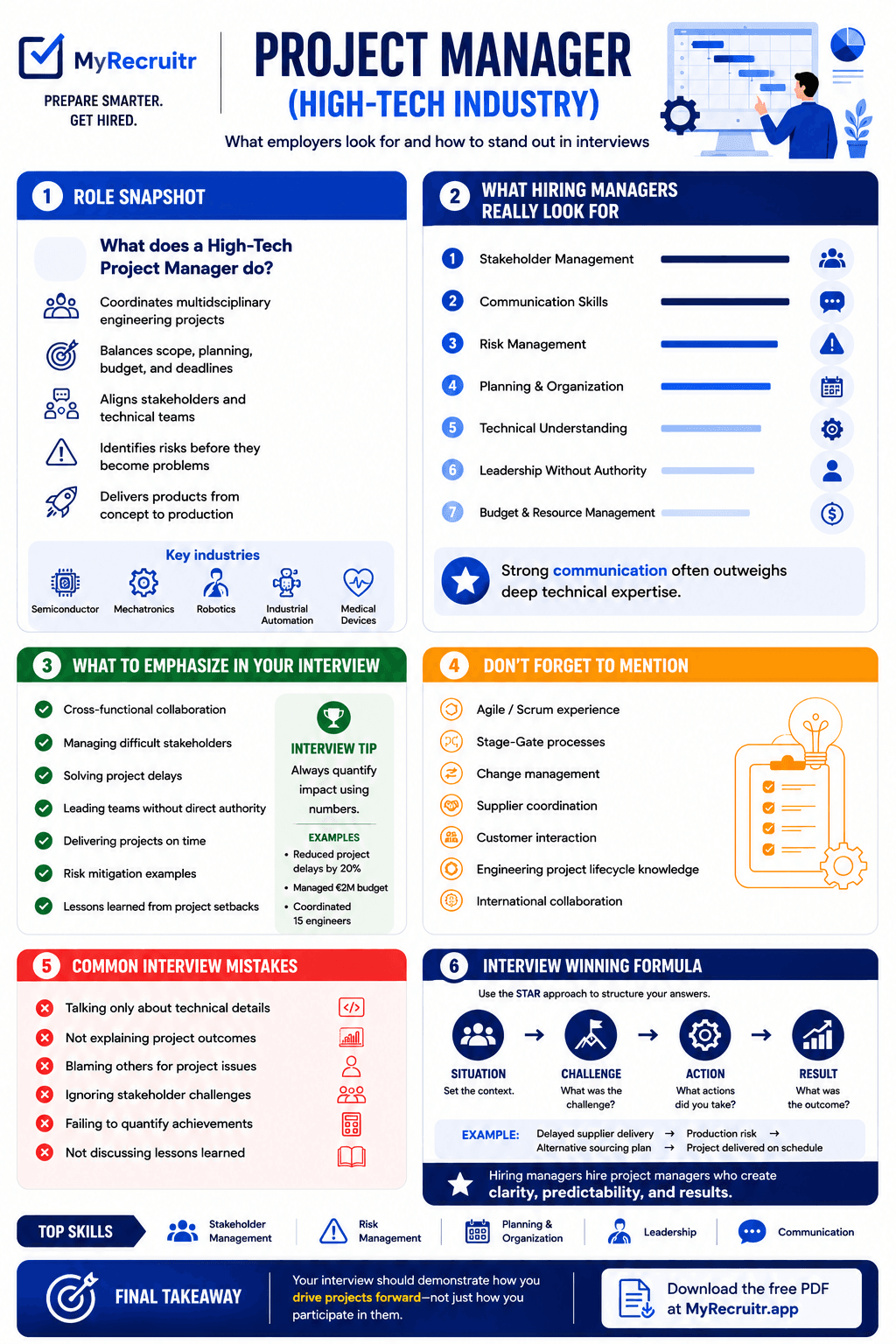
End-to-end ownership of technically complex projects: from requirements through delivery and handover
Experience managing cross-disciplinary teams (mechanical, electrical, software, systems)
Familiarity with structured development methodologies: V-model, stage-gate, or Agile at programme scale
Budget ownership and earned value management (EVM) — show the scale: team size, budget range, duration
Risk management: identification, mitigation plans, and active tracking through delivery
Stakeholder management at multiple levels: senior leadership, customers, and technical specialists
Knowledge of the domain: semiconductor equipment, medical devices, or defence systems are all valued differently
Top priorities for this role
What hiring managers rank highest when screening Project Leader in High-Tech Systems candidates.
Ability to manage technical risk proactively — not just reporting status but anticipating and mitigating problems
Stakeholder management at senior level — can you deliver bad news to a VP and still maintain trust?
Technical credibility — PMs who cannot understand the engineering decisions lose credibility with their teams
Scope management — how do you handle feature creep from customers or executives?
Cross-disciplinary coordination — high-tech projects involve mechanical, electrical, software, and supply chain simultaneously
Don't forget to mention
Agile or Scrum experience at programme scale, not just team level
Stage-Gate processes and formal milestone management
Change management: formal change requests, impact assessment, board approval
Supplier coordination and third-party management under contract
Customer-facing experience and expectation management
Full engineering project lifecycle: concept through production and handover
International collaboration across sites or organisations
Common interview mistakes
Describing project management activities without stating outcomes — always include on-time, on-budget, or quality results
No indication of project scale: a "complex project" could mean two engineers for three months or 80 engineers for three years
Listing methodologies (Agile, PMP, PRINCE2) without showing how you applied them in a high-tech context
Omitting the technical depth that sets a high-tech project leader apart from a generic PM — show your engineering background
Not naming the specific type of system delivered: lithography module, MRI subsystem, radar unit — domain context matters
Likely interview questions
Questions hiring managers commonly ask for Project Leader in High-Tech Systems roles in the Netherlands. Prepare concrete examples using the STAR method.
Q1
Describe the most complex technical programme you have led. What was the team size, budget, and duration?
Q2
Tell me about a time a project was significantly off track. What did you do to recover it?
Q3
How do you build trust with a technical team that is sceptical of project managers?
Q4
How do you handle a situation where a key stakeholder keeps adding requirements after scope is frozen?
Q5
Describe how you manage dependencies between teams on a large cross-functional programme.
Tips and tricks
Interview tip
Always quantify impact using numbers. Hiring managers remember "reduced delay by 20%" — they forget "managed a project".
Open each role with a one-line project description: system type, team size, budget, and duration
Quantify your delivery record: "delivered 3 of 3 major milestones on time", "recovered a 6-week slip within one quarter"
Show both upward and downward communication: managing board-level stakeholders AND technical leads on the same CV reads as genuine leadership
Certifications like PMP, IPMA-C/D, or SAFe are recognised but never a substitute for credible delivery experience — pair them with outcomes
In the Brainport context, fluency with ASML or Philips programme processes (PACE, DFx, stage-gate) is a strong differentiator — name any you have used
Interview winning formula
Use the STAR method to structure your answers: Situation → Challenge → Action → Result.
Key skills to include
Tools & technologies
Relevant standards & frameworks
Career progression
Typical growth path for Project Leader in High-Tech Systemss in the high-tech Netherlands ecosystem.
Stage 1
Project Coordinator / Junior PM — 0–3 years, supports senior PMs on large programmes
Stage 2
Project Manager — 3–7 years, leads projects up to €2M and 15-person teams independently
Stage 3
Senior Project Manager / Programme Manager — 7–12 years, manages multiple interdependent projects
Stage 4
Director of Programme Management — 12+ years, owns an entire product programme or business unit delivery
Stage 5
VP Engineering / COO track — leads engineering organisation or operations
Companies in the Brainport region
Deepen your knowledge
Academy topics that hiring managers expect Project Leader in High-Tech Systemss to understand.
See how your CV actually reads
Upload your CV and a vacancy. MyRecruitr reads it like a recruiter would and tells you exactly what to fix.
Analyse my Project Leader in High-Tech Systems CV →