Home→Interview Guides→Electronics Engineer
Electronics Engineer Interview Guide
Electronics Engineers are the backbone of every high-tech system in the Brainport region. From analog front-ends in medical devices to high-speed digital interfaces in semiconductor equipment, the demand for engineers who can design, verify, and debug complex electronics is consistently high — and the bar is rising.
Got a vacancy for this role? Get tailored interview prep →
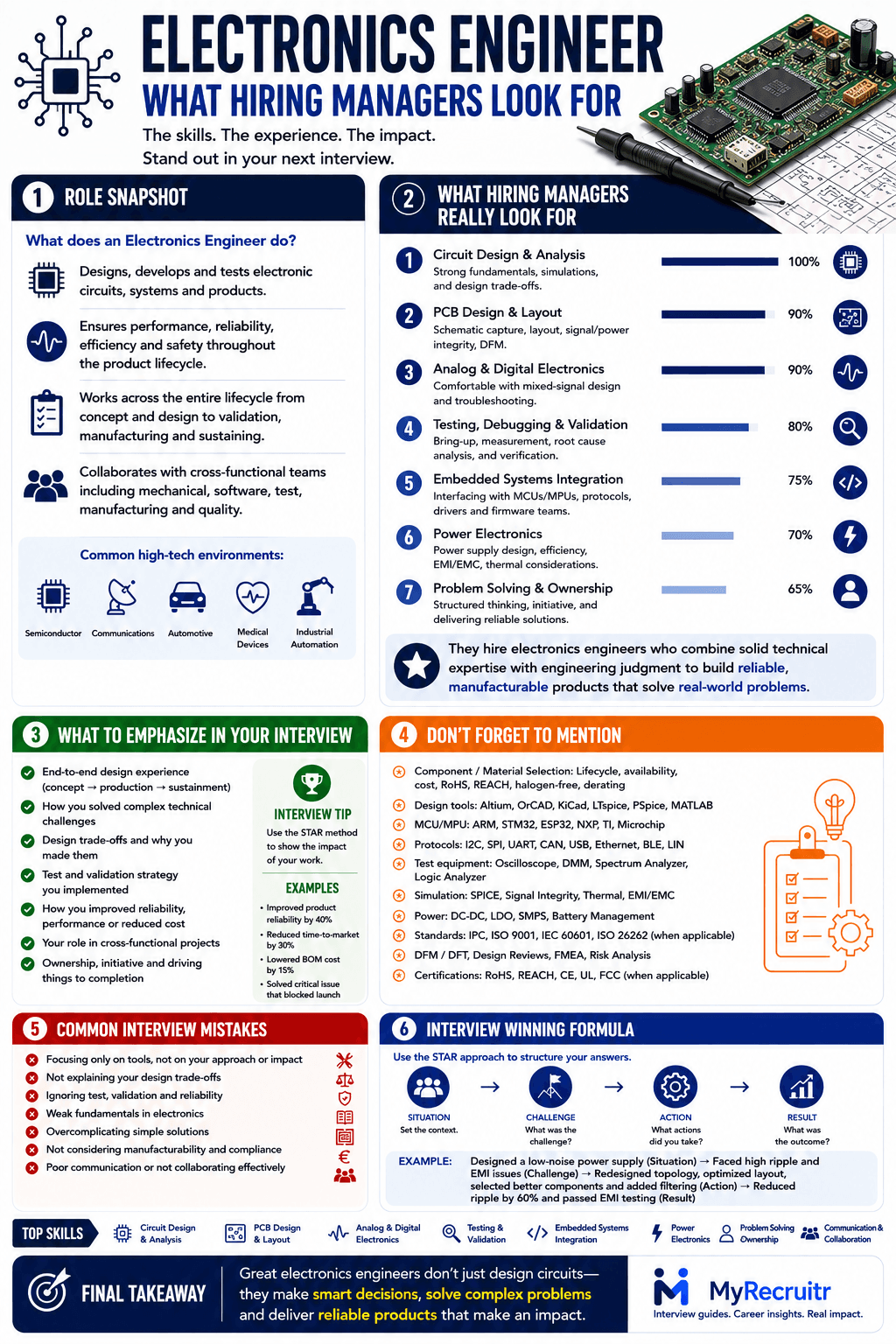
What hiring managers look for
Circuit design depth: analog, digital, mixed-signal, or power — be specific about your domain
PCB design experience: layout ownership, layer stack-up decisions, impedance control, and design-for-manufacture
Simulation and analysis tools: LTspice, MATLAB/Simulink, PSPICE, or equivalent — show you verified designs before building
Measurement and debug skills: oscilloscope, spectrum analyser, network analyser — mention the types of issues you have tracked down
EMC/EMI experience: conducted or radiated emissions, shielding strategies, filtering — regulatory context (CE, FCC) is a plus
Cross-disciplinary integration: evidence you worked alongside software, mechanical, or systems teams to make the full product work
Top priorities for this role
What hiring managers rank highest when screening Electronics Engineer candidates.
Schematic design and PCB layout depth — does your layout knowledge match your schematic ability?
Signal integrity and power integrity awareness — at what frequency do your layouts stop working?
Bring-up and debug experience — the value of an electronics engineer who can debug a board from scratch is enormous
EMC design practice — do you design for EMC from day one, or as a retrofit?
Cross-domain integration — electronics is always part of a larger system; integration experience is essential
Common interview mistakes
CVs that list tools and components without describing what you actually designed or what problem it solved
No mention of the system context: was this a consumer product, medical device, industrial machine, or semiconductor tool?
Omitting schematic and layout ownership — recruiters want to know if you own the full design or only a subsystem
Failing to quantify performance: bandwidth, noise floor, power efficiency, voltage regulation — numbers make the difference
Likely interview questions
Questions hiring managers commonly ask for Electronics Engineer roles in the Netherlands. Prepare concrete examples using the STAR method.
Q1
Walk me through the design of a power supply stage for a precision analog circuit. What are the key design decisions?
Q2
How do you approach PCB layout for a high-speed differential signal? What are your routing rules?
Q3
Describe a bring-up sequence for a new PCB. What do you check first and in what order?
Q4
You have a PCB that is failing EMC radiated emission testing at 240 MHz. What is your systematic debug approach?
Q5
How do you choose between different microcontrollers for a new design? What criteria matter most?
Tips and tricks
Interview tip
Be ready to walk through a design you built — why you chose that topology, what went wrong, and what you would change. Hiring managers in Brainport companies want to see engineering judgement, not just execution.
Lead with the system: "designed the power distribution network for a 200W precision motion stage" beats "PCB design experience"
State your tool chain: KiCad, Altium, OrCAD — and the complexity (layer count, board area, high-speed signals)
If you have brought a board from prototype to production, describe what changed between the two — that signals maturity
EMC is a weak spot for many engineers; if you have solved an EMC failure in the field, describe that story
Key skills to include
Tools & technologies
Relevant standards & frameworks
Career progression
Typical growth path for Electronics Engineers in the high-tech Netherlands ecosystem.
Stage 1
Junior Electronics Engineer — 0–3 years, designs subsections of boards, supports bring-up
Stage 2
Electronics Engineer — 3–6 years, owns PCB designs from schematic to tested hardware
Stage 3
Senior Electronics Engineer — 6–10 years, leads electronics architecture for new products
Stage 4
Principal Electronics Engineer / Hardware Architect — 10+ years, defines electronics platform strategy
Stage 5
Chief Electronics Engineer / CTO track — executive technical leadership in hardware-driven companies
Companies in the Brainport region
Deepen your knowledge
Academy topics that hiring managers expect Electronics Engineers to understand.
See how your CV actually reads
Upload your CV and a vacancy. MyRecruitr reads it like a recruiter would and tells you exactly what to fix.
Analyse my Electronics Engineer CV →