Home→Interview Guides→Supplier Quality Engineer
Supplier Quality Engineer Interview Guide
Supplier Quality Engineers own the quality of everything a company does not make itself — a critical role in the Netherlands high-tech sector, where complex products depend on deep, multi-tier supply chains. At companies like ASML, Philips, and NXP, an SQE qualifies suppliers, drives their process capability, and leads 8D investigations when something goes wrong two or three tiers upstream. Recruiters look for engineers who can show they changed a supplier's behaviour, not just documented a nonconformance.
Got a vacancy for this role? Get tailored interview prep →
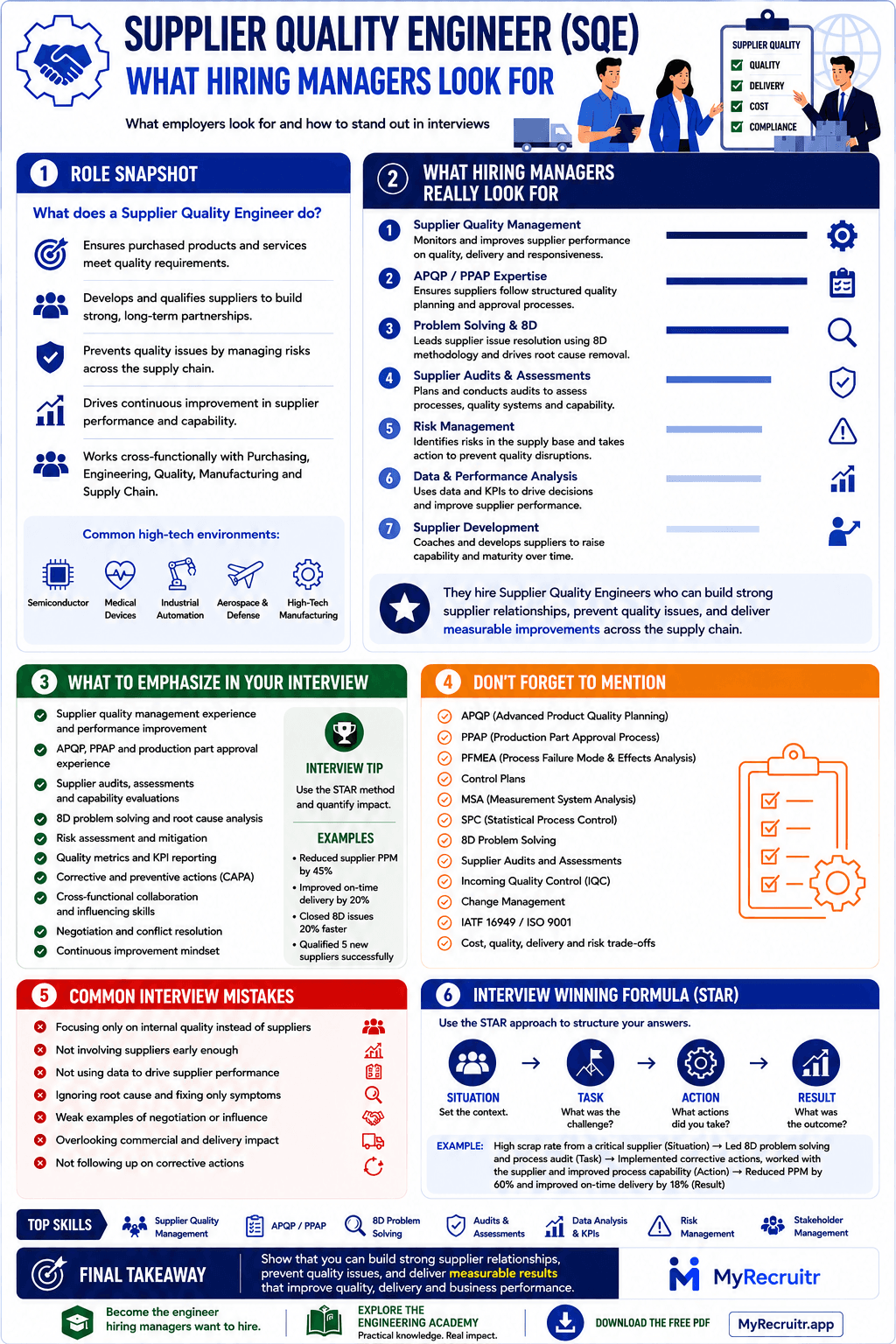
What hiring managers look for
Supplier quality management: monitoring and improving supplier performance across quality, delivery, cost, and responsiveness simultaneously
APQP/PPAP expertise: ensuring suppliers follow structured quality planning and part approval processes, not just checking a box at the end
Problem solving and 8D: leading supplier issue resolution through structured root cause removal, not just escalation
Supplier audits and assessments: planning and conducting audits that actually assess process and quality system capability
Risk management: identifying risks in the supply base before they become quality disruptions
Data and performance analysis: using supplier KPIs and data to drive decisions, not relying on supplier self-reporting
Top priorities for this role
What hiring managers rank highest when screening Supplier Quality Engineer candidates.
Influence without authority — SQEs must change supplier behaviour despite having no direct control over the supplier's organisation
Root cause discipline — an 8D that stops at containment rather than eliminating the underlying cause is treated as incomplete work
APQP/PPAP fluency at the level of practice, not theory — which elements applied, at what submission level, and why
Data-driven supplier management — PPM, on-time delivery, and audit findings used to prioritise action, not supplier reassurance taken at face value
Commercial awareness — understanding how a quality decision affects cost and delivery, and being able to defend a decision in those terms
Don't forget to mention
APQP (Advanced Product Quality Planning) — your role in the process with new or changed suppliers
PPAP (Production Part Approval Process) — submission levels you have worked with and reviewed
PFMEA — supplier process FMEAs you reviewed or influenced
Control plans and MSA studies you evaluated as part of supplier qualification
SPC data you used to monitor or challenge supplier process capability
8D problem solving — investigations you led and how you verified root cause removal
Supplier audits and incoming quality control (IQC) experience, and IATF 16949 / ISO 9001 context where relevant
Common interview mistakes
Focusing only on internal quality work instead of supplier-facing experience — this role is fundamentally about influencing an external organisation
Not involving suppliers early enough in the process — SQE work that starts after a part fails reads as reactive, not preventive
No evidence of using data to drive supplier performance — quality metrics and PPM trends are the language of this role
Ignoring root cause and only fixing symptoms — an 8D that stops at containment, not root cause removal, is incomplete
Weak or absent examples of negotiation or influence — SQEs rarely have direct authority over suppliers and must show they can drive change anyway
Overlooking the commercial and delivery impact of supplier quality decisions — cost, quality, and delivery trade-offs are constant in this role
Likely interview questions
Questions hiring managers commonly ask for Supplier Quality Engineer roles in the Netherlands. Prepare concrete examples using the STAR method.
Q1
Walk me through an 8D you led with a supplier. How did you confirm the root cause was actually eliminated, not just contained?
Q2
How do you handle a supplier who resists implementing a corrective action you believe is necessary?
Q3
What PPAP elements would you require differently for a Level 3 versus a Level 5 submission, and why?
Q4
Describe how you have used supplier PPM or delivery data to change how you allocated your attention across a supply base.
Q5
Tell me about a supplier audit that revealed a bigger problem than you expected. What did you do next?
Tips and tricks
Interview tip
Use the STAR method and quantify impact. Hiring managers want a specific supplier story: what was wrong, how you got a supplier without direct authority over them to act, and the number that improved.
Use the STAR method and quantify impact: PPM reduction, on-time delivery improvement, or 8D closure time are the metrics hiring managers expect
Name your APQP/PPAP involvement specifically: which elements you owned, and at what submission level
Describe a supplier audit you led or contributed to, and what capability gap it uncovered
If you have qualified new suppliers, state how many and what the qualification process involved
Show negotiation and influence explicitly — a story where a supplier resisted a corrective action and you got them to act anyway is a strong signal
Interview winning formula
Use the STAR method to structure your answers: Situation → Challenge → Action → Result.
Key skills to include
Tools & technologies
Relevant standards & frameworks
Career progression
Typical growth path for Supplier Quality Engineers in the high-tech Netherlands ecosystem.
Stage 1
Supplier Quality Engineer I — 0–3 years, supports supplier audits and PPAP review under guidance
Stage 2
Supplier Quality Engineer II — 3–6 years, owns a supplier portfolio independently, leads 8Ds and qualifications
Stage 3
Senior Supplier Quality Engineer — 6–10 years, leads supplier development strategy across a commodity or region
Stage 4
Supplier Quality Manager — 10+ years, owns the supplier quality function across a site or business unit
Stage 5
Director of Supply Chain Quality — leadership track into broader supply chain or quality management
Companies in the Brainport region
Deepen your knowledge
Academy topics that hiring managers expect Supplier Quality Engineers to understand.
See how your CV actually reads
Upload your CV and a vacancy. MyRecruitr reads it like a recruiter would and tells you exactly what to fix.
Analyse my Supplier Quality Engineer CV →