Home→Interview Guides→Equipment Engineer
Equipment Engineer Interview Guide
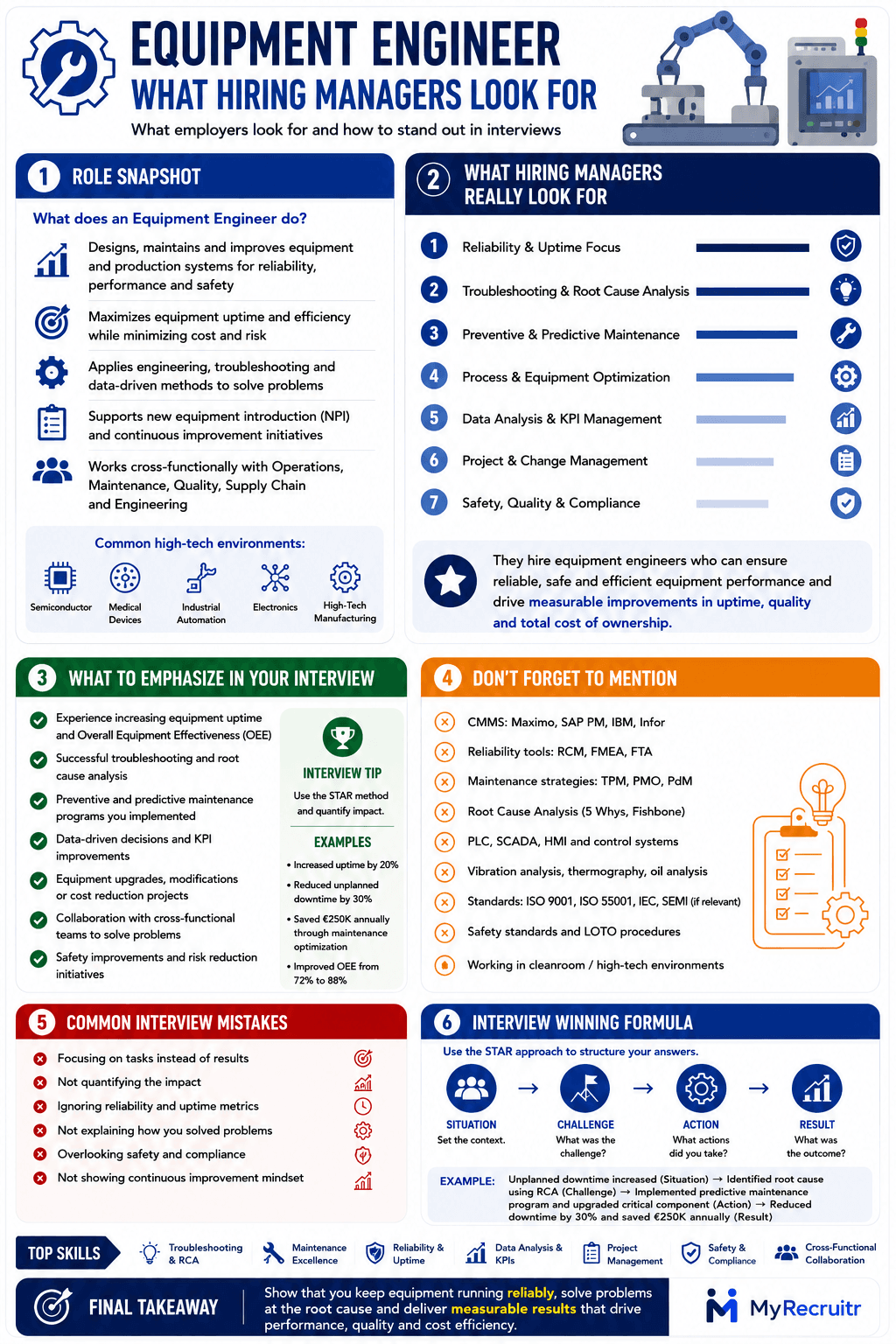
Equipment Engineers keep the machines that make everything else possible running reliably, safely, and efficiently. In the Netherlands semiconductor and high-tech manufacturing sector, this means owning uptime and OEE on complex, capital-intensive equipment — often in cleanroom or otherwise controlled environments — while balancing preventive maintenance against production schedules that cannot slip. Recruiters look for engineers who troubleshoot to root cause, not just clear the alarm and move on.
Got a vacancy for this role? Get tailored interview prep →
What hiring managers look for
Reliability and uptime focus: a track record of keeping specific equipment running, measured in uptime percentage or OEE, not just "supporting the line"
Troubleshooting and root cause analysis: diagnosing the actual failure mechanism on complex equipment, not just replacing the most obvious part
Preventive and predictive maintenance: designing or improving maintenance programmes, not just following a schedule someone else wrote
Process and equipment optimisation: tuning equipment parameters and processes to reduce cost, downtime, or defects
Data analysis and KPI management: using CMMS and process data to justify maintenance decisions, not relying on instinct
Safety, quality, and compliance awareness: equipment work carries real physical risk, and hiring managers expect fluency in LOTO and relevant standards
Top priorities for this role
What hiring managers rank highest when screening Equipment Engineer candidates.
Diagnostic depth — can you trace an equipment failure to its root cause, or do you stop once the symptom clears?
Ownership of uptime as a metric — equipment engineers who track and are accountable for OEE behave differently than those who just respond to tickets
Predictive over reactive maintenance — has the candidate built or improved a maintenance programme, or only followed one?
Control systems fluency — comfort with PLC, SCADA, and HMI environments is assumed, not a nice-to-have, on complex high-tech equipment
Safety judgement — equipment work carries real physical risk, and hiring managers need confidence in LOTO and safety discipline
Don't forget to mention
CMMS systems you have used: Maximo, SAP PM, IBM Maximo, or Infor EAM
Reliability tools by name: RCM, FMEA, FTA — and how you applied them to equipment
Maintenance strategies you have implemented: TPM, PdM, or a formal PM optimisation programme
Root cause analysis methods: 5 Whys, Fishbone, and a specific investigation you led
Control systems experience: PLC, SCADA, HMI — and the platforms you have worked with
Condition monitoring techniques: vibration analysis, thermography, or oil analysis
Safety standards and LOTO procedures, and any cleanroom or controlled-environment manufacturing experience
Common interview mistakes
Describing tasks completed instead of the uptime, OEE, or cost result they produced
Not quantifying impact: equipment engineering is measured continuously, and a CV without numbers reads as unfinished
Ignoring reliability and uptime metrics entirely in favour of a list of equipment worked on
Not explaining how a problem was actually solved — hiring managers want the diagnostic path, not just the outcome
Overlooking safety and compliance — omitting LOTO, EHS, or relevant equipment safety standards is a red flag in this role
No evidence of a continuous improvement mindset — equipment engineers who only fix what breaks are less valued than those who prevent it
Likely interview questions
Questions hiring managers commonly ask for Equipment Engineer roles in the Netherlands. Prepare concrete examples using the STAR method.
Q1
Walk me through the last equipment failure you root-caused. What was your diagnostic process?
Q2
How do you decide whether a piece of equipment needs a predictive maintenance programme versus a standard preventive schedule?
Q3
Describe how you have used condition monitoring — vibration analysis, thermography, or oil analysis — to catch a failure before it happened.
Q4
Tell me about a time you had to balance a production schedule against a maintenance need. How did you resolve it?
Q5
What is your approach to LOTO and safety when troubleshooting live or partially live equipment?
Tips and tricks
Interview tip
Use the STAR method and quantify impact. Hiring managers want the diagnostic story — how you found the root cause — and the uptime or cost number that resulted.
Use the STAR method and quantify impact: uptime gained, downtime reduced, or cost saved through maintenance optimisation
Name the CMMS and control systems you have worked with — Maximo, SAP PM, PLC/SCADA/HMI — hiring managers screen for this fluency
Describe a specific troubleshooting story: the symptom, your diagnostic approach, the root cause, and the fix
If you introduced or improved a predictive maintenance programme, describe what triggered it and what technique you used — vibration analysis, thermography, oil analysis
Mention cleanroom or controlled-environment experience explicitly if relevant — it signals familiarity with the constraints of high-tech manufacturing
Interview winning formula
Use the STAR method to structure your answers: Situation → Challenge → Action → Result.
Key skills to include
Tools & technologies
Relevant standards & frameworks
Career progression
Typical growth path for Equipment Engineers in the high-tech Netherlands ecosystem.
Stage 1
Equipment Engineer I — 0–3 years, supports maintenance and troubleshooting under guidance
Stage 2
Equipment Engineer II — 3–6 years, owns uptime and maintenance strategy for specific equipment independently
Stage 3
Senior Equipment Engineer — 6–10 years, leads equipment strategy and capital planning across a production area
Stage 4
Principal Equipment Engineer / Equipment Manager — 10+ years, owns the equipment engineering function across a site
Stage 5
Director of Operations / VP Manufacturing — leadership track into broader operations ownership
Companies in the Brainport region
Deepen your knowledge
Academy topics that hiring managers expect Equipment Engineers to understand.
See how your CV actually reads
Upload your CV and a vacancy. MyRecruitr reads it like a recruiter would and tells you exactly what to fix.
Analyse my Equipment Engineer CV →