Home→Interview Guides→Test & Validation Engineer
Test & Validation Engineer Interview Guide
Test and Validation Engineers are essential in every high-tech programme — yet their CVs are often the weakest in the applicant pool. Done well, a test engineering CV shows systematic thinking, deep product knowledge, and the ability to find problems nobody else found. That profile is in high demand across Brainport.
Got a vacancy for this role? Get tailored interview prep →
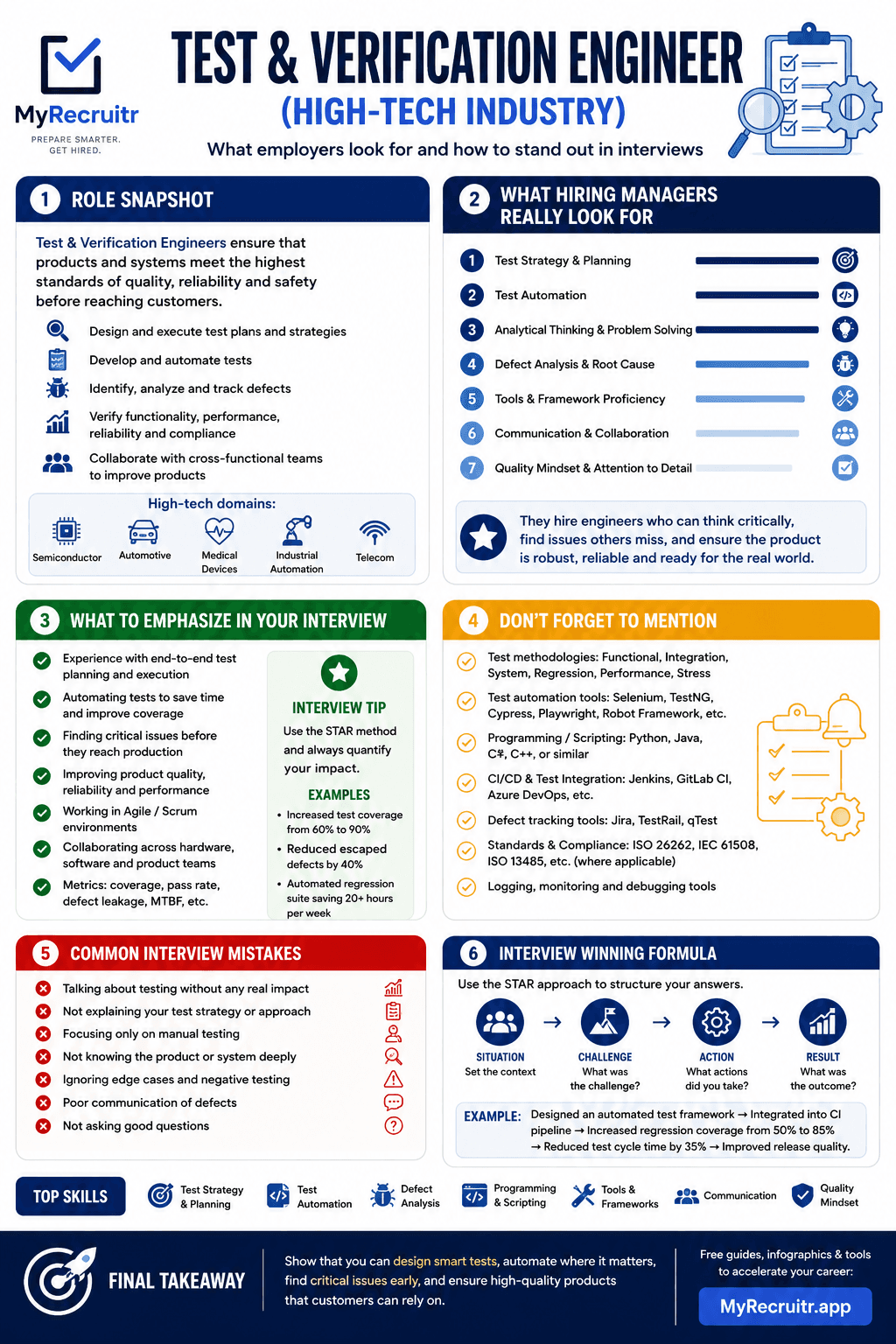
What hiring managers look for
Test strategy ownership: evidence you designed a test approach, not just executed someone else's scripts
Automation experience: Python, pytest, Robot Framework, LabVIEW, or domain-specific test frameworks
Hardware-in-the-loop (HIL) or software-in-the-loop (SIL) test bench development
Requirements traceability: linking test cases to system requirements (DOORS, Polarion, or equivalent)
Defect tracking and root-cause analysis: Jira, DOORS, or custom tools — show your diagnostic process
Domain knowledge of the system under test: mechanical, optical, electrical, or software subsystems
Top priorities for this role
What hiring managers rank highest when screening Test & Validation Engineer candidates.
Test strategy ownership — can you define a test plan that proves system requirements are met, not just that common paths work?
Requirements traceability — is every test linked to a requirement, and vice versa?
Test automation capability — manual testing at scale is unsustainable; automation is expected
Root cause orientation — do you stop at "the test failed" or do you dig until you understand why?
Cross-functional integration — validation engineers must understand the system well enough to question design decisions
Common interview mistakes
CVs that list "testing" as a task rather than as a discipline with its own methodology and outcomes
No mention of test coverage or defect escape rate — these are the KPIs that matter
Omitting the type of test: unit, integration, system, acceptance, environmental, or reliability
Not showing how testing findings fed back into product design — closed-loop contribution is a differentiator
Likely interview questions
Questions hiring managers commonly ask for Test & Validation Engineer roles in the Netherlands. Prepare concrete examples using the STAR method.
Q1
How do you develop a test strategy for a new product? Where do you start?
Q2
Walk me through a test that revealed an unexpected system behaviour. What happened and what was the root cause?
Q3
How do you prioritise test cases when you have limited time before a product release?
Q4
Describe your approach to test automation. What would you automate first and why?
Q5
How do you handle a situation where a test requirement is ambiguous — the specification is unclear about the expected result?
Tips and tricks
Lead with a test outcome: "developed automated regression suite that reduced validation cycle from 3 weeks to 4 days"
Name the systems you validated — complexity and criticality of the product signals your experience level
If you have found a showstopper defect late in a programme, describe how you handled the escalation
Certifications like ISTQB are recognised but not required — real test outcomes carry more weight
Key skills to include
Tools & technologies
Relevant standards & frameworks
Career progression
Typical growth path for Test & Validation Engineers in the high-tech Netherlands ecosystem.
Stage 1
Test Engineer — 0–3 years, executes test plans, logs defects, supports automation
Stage 2
Senior Test / Validation Engineer — 3–7 years, designs test strategies, owns automation framework
Stage 3
Lead Test Engineer / Validation Architect — 7–12 years, defines validation methodology across programmes
Stage 4
Principal Test Engineer — 12+ years, sets testing standards and toolchain strategy
Stage 5
Head of Quality / Validation — leadership track into quality management
Companies in the Brainport region
Deepen your knowledge
Academy topics that hiring managers expect Test & Validation Engineers to understand.
See how your CV actually reads
Upload your CV and a vacancy. MyRecruitr reads it like a recruiter would and tells you exactly what to fix.
Analyse my Test & Validation Engineer CV →