Home→Interview Guides→Reliability Engineer
Reliability Engineer Interview Guide
Reliability Engineers exist to find out how a product fails before a customer does. In the Netherlands high-tech sector — semiconductor equipment, medical devices, aerospace & defence, and industrial automation — that means combining failure analysis, structured testing, and statistical rigour to predict and prevent problems long before they reach the field. Recruiters screen hard for engineers who can point to a specific failure mode they found, quantified, and eliminated, not just people who ran a test plan someone else designed.
Got a vacancy for this role? Get tailored interview prep →
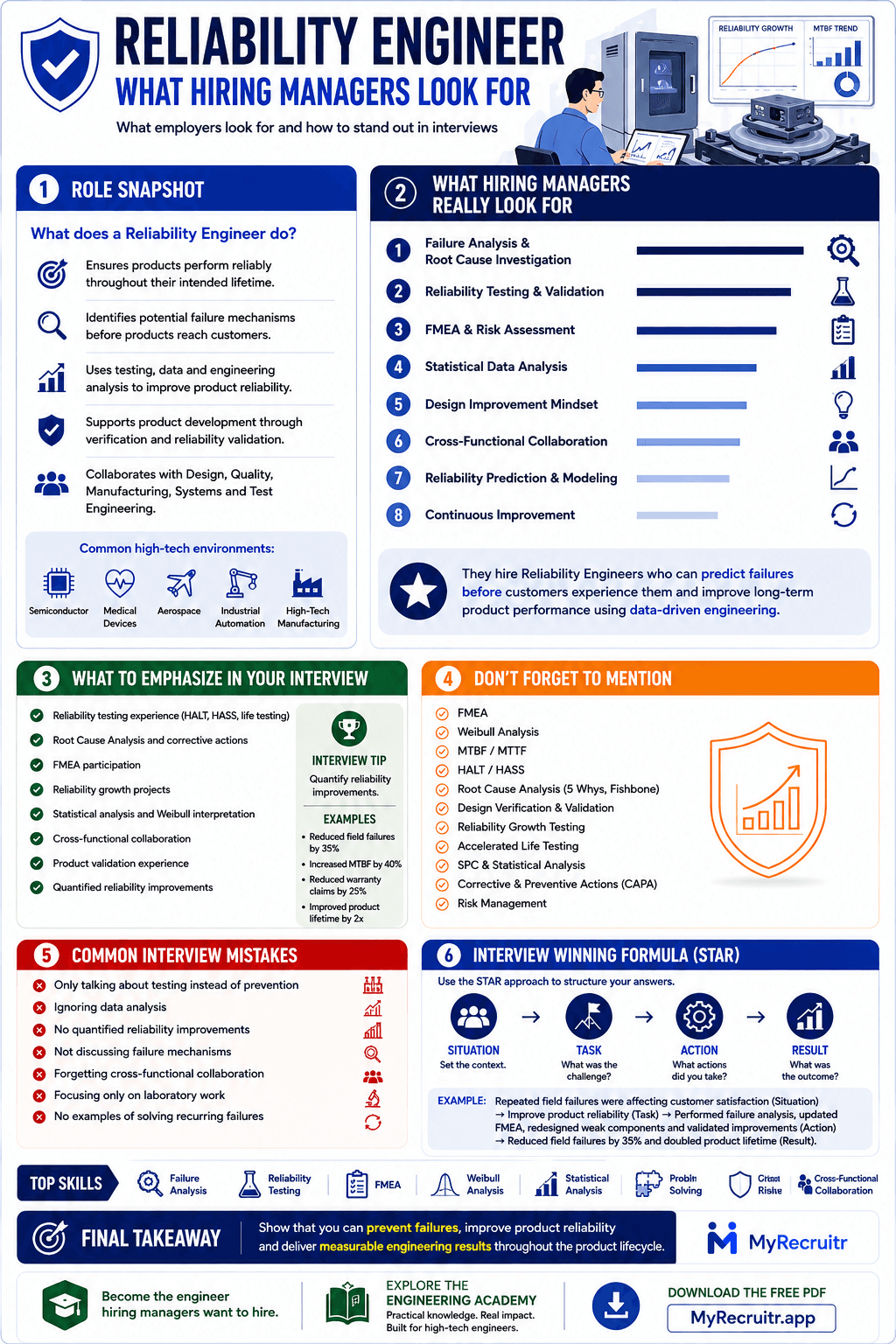
What hiring managers look for
Failure analysis and root cause investigation: the ability to trace a field or lab failure back to its physical mechanism, not just its symptom
Reliability testing and validation experience: HALT, HASS, and life testing — designed, executed, and interpreted, not just observed
FMEA and risk assessment: contributing to or leading design and process FMEAs that actually changed a design before it shipped
Statistical data analysis: comfort with Weibull analysis, MTBF/MTTF calculation, and reliability prediction, backed by real project data
A design improvement mindset: using reliability findings to change a design or process, not just document a failure and move on
Cross-functional collaboration: reliability engineers only succeed if Design, Quality, Manufacturing, Systems, and Test engineering all act on their findings
Top priorities for this role
What hiring managers rank highest when screening Reliability Engineer candidates.
Evidence of finding failure mechanisms, not just running tests — the value is in the diagnosis, not the test plan execution
Statistical fluency under real conditions — can you explain a Weibull plot or MTBF calculation from an actual project, not just the textbook definition?
Influence over design decisions — reliability findings that never changed a design signal a role that stayed purely observational
Comfort with accelerated and destructive testing — HALT and HASS require judgement about where to push a design past its limits
Cross-functional credibility — Design and Manufacturing need to trust a reliability engineer's data enough to act on it under schedule pressure
Don't forget to mention
FMEA participation — design FMEA, process FMEA, and the specific risks you identified
Weibull analysis and what it told you about a failure population
MTBF / MTTF figures you calculated or improved, and how
HALT / HASS testing — what you tested to, what failed, and what changed as a result
Root cause analysis methods you used: 5 Whys, Fishbone, or a formal RCA process
Design verification and validation work tied to reliability requirements
SPC and statistical analysis applied to reliability or field data
Common interview mistakes
Talking only about the tests run, not the failures found and what was done about them
No quantified reliability improvement — MTBF gains, field failure reduction, or warranty claim reduction are the currency of this role
Ignoring data analysis: describing a test campaign without the statistical interpretation that made it useful
Not naming specific failure mechanisms uncovered — vague claims of "improved reliability" read as unconvincing
Forgetting cross-functional collaboration: reliability findings only matter if they changed a Design or Manufacturing decision
Presenting reliability work as purely a lab function, with no evidence of driving change upstream
Likely interview questions
Questions hiring managers commonly ask for Reliability Engineer roles in the Netherlands. Prepare concrete examples using the STAR method.
Q1
Walk me through a failure you diagnosed from field or lab data. What was the mechanism, and how did you confirm it?
Q2
How do you decide when a HALT result represents a real reliability risk versus an artefact of over-stressing the design?
Q3
Explain how you would interpret a Weibull plot with a shape parameter below 1. What does it tell you about the failure mode?
Q4
Describe a time your reliability data was met with resistance from a design team. How did you make the case?
Q5
How do you calculate and communicate MTBF in a way that is useful to a programme manager who is not statistically trained?
Tips and tricks
Interview tip
Quantify your reliability improvements. Hiring managers want the failure mechanism, the method that found it, and the number that changed once it was fixed.
Lead with the failure you found and fixed: the mechanism, the method used to find it, and the reliability metric that improved as a result
Name your test methods explicitly: HALT, HASS, or a specific accelerated life test protocol, and the sample sizes and durations involved
Show your statistical fluency: mention Weibull analysis, MTBF/MTTF, or reliability prediction models by name, tied to a real project
Quantify in the terms hiring managers expect: percentage reduction in field failures, MTBF improvement, or warranty cost avoided
If you influenced a design change based on your findings, describe the resistance you faced and how you made the case with data
Interview winning formula
Use the STAR method to structure your answers: Situation → Challenge → Action → Result.
Key skills to include
Tools & technologies
Relevant standards & frameworks
Career progression
Typical growth path for Reliability Engineers in the high-tech Netherlands ecosystem.
Stage 1
Reliability Engineer I — 0–3 years, executes test plans and supports failure analysis under guidance
Stage 2
Reliability Engineer II — 3–6 years, owns reliability testing and FMEA input for a subsystem independently
Stage 3
Senior Reliability Engineer — 6–10 years, leads reliability strategy across a product programme
Stage 4
Principal Reliability Engineer — 10+ years, defines reliability methodology and standards across a product line
Stage 5
Reliability Engineering Manager / Director — leadership track into broader quality or engineering management
Companies in the Brainport region
Deepen your knowledge
Academy topics that hiring managers expect Reliability Engineers to understand.
See how your CV actually reads
Upload your CV and a vacancy. MyRecruitr reads it like a recruiter would and tells you exactly what to fix.
Analyse my Reliability Engineer CV →