Home→Interview Guides→Systems Architect
Systems Architect Interview Guide
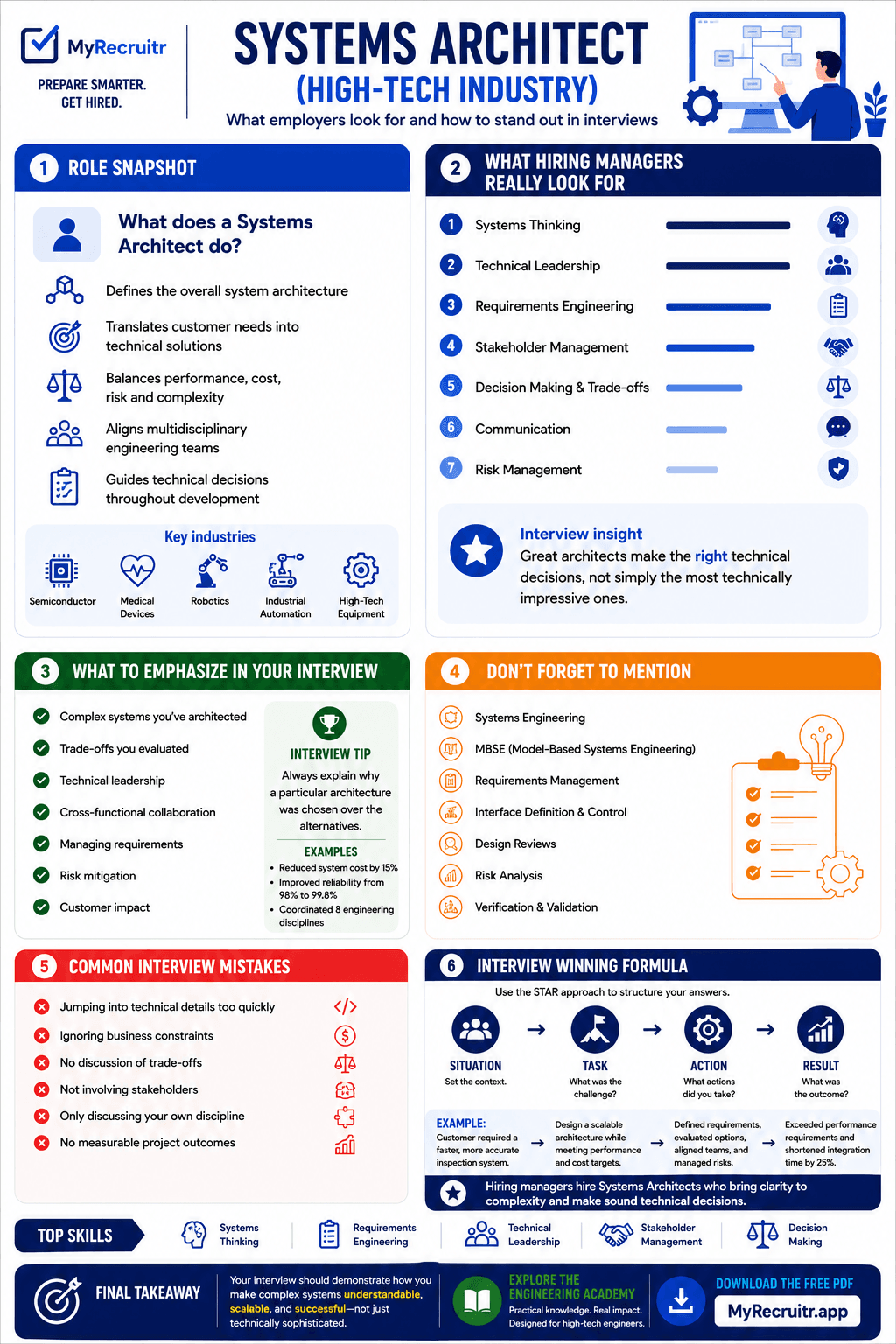
Systems Architects define the technical backbone that everything else gets built on. In the Netherlands high-tech sector, this is a senior, high-trust role: ASML architects decide how a lithography machine's subsystems fit together for the next decade, Philips architects do the same for a medical imaging platform. The role sits above systems engineering — architects own the trade-offs that shape cost, performance, and evolvability for years after the decision is made, so recruiters expect both deep technical credibility and the judgement to defend a decision under pressure.
Got a vacancy for this role? Get tailored interview prep →
What hiring managers look for
Track record of owning system-level architecture decisions, not just contributing to them: partitioning, interfaces, and technology choices you defended and stand behind
Trade-off reasoning: the ability to articulate why one architecture was chosen over credible alternatives — cost, performance, risk, and time-to-market all weighed explicitly
Depth in at least one discipline (mechanical, electrical, software, or systems) combined with genuine fluency across the others — architects cannot design in isolation from any of them
Experience with architecture frameworks and modelling: SysML, C4, ADLs, or equivalent structured approaches to describing a system
Long-horizon thinking: designing for platform reuse, modularity, and evolvability rather than optimising a single product generation
Influence without direct authority: architects steer engineering teams, product management, and senior stakeholders toward a shared technical direction
Top priorities for this role
What hiring managers rank highest when screening Systems Architect candidates.
Evidence of owning architecture decisions, not just documenting requirements — architects are judged on the calls they made
Ability to defend a decision against credible alternatives with clear, weighted trade-off reasoning
Cross-disciplinary fluency: comfort operating across mechanical, electrical, and software boundaries at once
Long-horizon thinking — architecture decisions that held up across product generations, not just a single release
Influence and communication — architects steer engineering direction without direct authority over the teams involved
Don't forget to mention
Architecture decisions you personally owned, including the alternatives you rejected and why
The modelling or documentation approach you used to communicate the architecture: SysML, block diagrams, ADRs
How your architecture was verified or stress-tested against requirements before implementation began
Cross-disciplinary fluency: mechanical, electrical, and software boundaries you have architected across
Platform or reuse thinking: architecture decisions that paid off across more than one product
Formal design review experience: PDR, CDR, or architecture board participation and outcomes
How you handled disagreement with senior engineers or stakeholders about an architecture direction
Common interview mistakes
Presenting architecture work as a list of diagrams produced rather than decisions made and their consequences
Not naming the alternatives that were rejected — an architecture decision only reads as credible when the road not taken is explicit
Conflating systems engineering (requirements, verification, interfaces) with systems architecture (structural decisions with long-term consequences) — these are related but distinct
No evidence of technical depth in any single discipline — architects who cannot go deep anywhere struggle to earn engineering team trust
Omitting the scale and lifespan of the system: a platform architecture decision that must last a decade reads very differently from a single product
Not showing how the architecture survived contact with real constraints — supplier limitations, cost targets, or a late-breaking requirement change
Likely interview questions
Questions hiring managers commonly ask for Systems Architect roles in the Netherlands. Prepare concrete examples using the STAR method.
Q1
Walk me through an architecture decision you made and the alternatives you rejected. What criteria decided it?
Q2
How do you balance short-term delivery pressure against a long-term platform architecture decision?
Q3
Describe a time your architecture had to change after a late requirement or constraint appeared. How did you handle it?
Q4
How do you communicate an architecture decision to engineers who disagree with it?
Q5
What is the difference between systems engineering and systems architecture in your view, and where does the boundary sit in your experience?
Tips and tricks
Interview tip
Architects are hired on judgement, not just knowledge. Prepare a story where you chose one architecture over a credible alternative — and explain what would have made you choose differently.
Open each role with the system and its scale: what it was, how many subsystems, how many engineers built against your architecture
Name a specific architecture decision you made, the alternatives you considered, and the criteria that decided it — this is the centrepiece of an architect CV
Show how your architecture aged: did it accommodate a requirement nobody anticipated, or scale to a follow-on product? Evolvability is the real test
If you have run or contributed to formal architecture reviews (PDR, CDR, architecture board), name them — it signals your decisions face real scrutiny
For ASML and Philips-style roles, emphasise experience architecting across mechanical, electrical, and software boundaries simultaneously — narrow specialists rarely land senior architect roles
Interview winning formula
Use the STAR method to structure your answers: Situation → Challenge → Action → Result.
Key skills to include
Tools & technologies
Relevant standards & frameworks
Career progression
Typical growth path for Systems Architects in the high-tech Netherlands ecosystem.
Stage 1
Senior Systems Engineer — 5–10 years, owns architecture for a major subsystem under an architect's direction
Stage 2
Systems Architect — 10–15 years, owns architecture for a full system or product
Stage 3
Principal / Chief Architect — 15+ years, defines platform architecture strategy across a product family
Stage 4
Distinguished Engineer / VP Engineering track — organisation-wide technical authority or leadership
Companies in the Brainport region
Deepen your knowledge
Academy topics that hiring managers expect Systems Architects to understand.
See how your CV actually reads
Upload your CV and a vacancy. MyRecruitr reads it like a recruiter would and tells you exactly what to fix.
Analyse my Systems Architect CV →