Home→Interview Guides→NPI Engineer
NPI Engineer Interview Guide
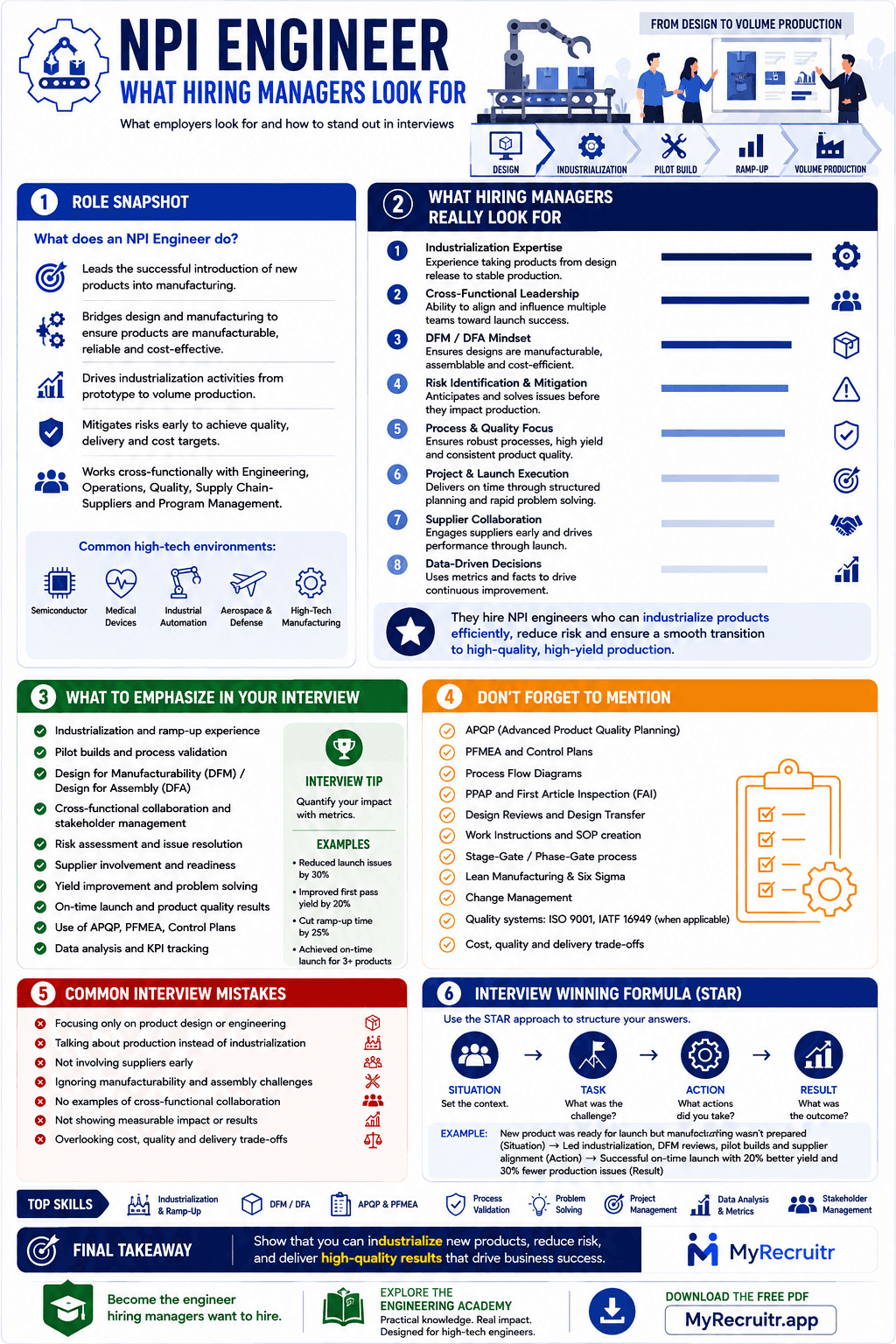
NPI Engineers own the handoff that makes or breaks a product launch: turning a design that works in the lab into one that can be built reliably, at cost, at volume. In the Netherlands high-tech sector — semiconductor, medical devices, industrial automation, and aerospace & defence — this means running industrialisation from pilot build through ramp-up while design, operations, quality, and suppliers all pull in different directions. Recruiters treat NPI as a proving ground for future manufacturing and operations leaders, and they screen hard for engineers who have actually carried a product across that line, not just supported it.
Got a vacancy for this role? Get tailored interview prep →
What hiring managers look for
Industrialisation expertise: hands-on experience taking a product from design release through pilot build to stable volume production, not just observing the process
Cross-functional leadership: the ability to align engineering, operations, quality, supply chain, and program management toward a single launch date without formal authority over most of them
DFM/DFA mindset: catching manufacturability and assembly problems during design review, before they become production issues
Risk identification and mitigation: anticipating what will go wrong at ramp-up and building the plan that prevents it, not just reacting when it happens
Process and quality focus: building robust processes that hold high yield and consistent quality from the first pilot lot onward
Supplier collaboration: engaging suppliers early and driving their readiness, since a launch is only as ready as its weakest supplier
Top priorities for this role
What hiring managers rank highest when screening NPI Engineer candidates.
Repeatable launch delivery — can you show more than one product carried successfully from design release to volume, not a single lucky launch?
Cross-functional pull without formal authority — NPI engineers get design, quality, operations, and suppliers moving on the same timeline without owning any of those teams
Early involvement in design — the best NPI engineers catch manufacturability problems in design review, not on the pilot line
Comfort owning risk — ramp-up always surfaces problems nobody predicted; can you build the mitigation plan before they land?
Data discipline — decisions backed by yield, defect, and capability data rather than instinct or supplier assurances
Don't forget to mention
APQP (Advanced Product Quality Planning) — the phases you owned and what you delivered in each
PFMEA and control plans you authored or contributed to before production start
Process flow diagrams, work instructions, and SOPs you created or updated for a new line or process
PPAP and First Article Inspection (FAI) — your role in supplier or internal qualification
Design reviews and design transfer — the specific manufacturability issues you caught before they hit production
Stage-gate or phase-gate process experience, and which gates you were accountable for
Quality systems you worked under where relevant: ISO 9001, IATF 16949
Common interview mistakes
Talking only about product design or engineering work, without addressing the industrialisation and ramp-up phase recruiters are actually screening for
Describing production experience instead of industrialisation experience — running an established line is a different job from standing one up
No mention of supplier involvement, or involving suppliers only late in the process instead of during design
Ignoring manufacturability and assembly challenges — a CV with no DFM/DFA story reads as design-side only
No examples of cross-functional collaboration — NPI is a coordination role, and hiring managers need to see you operating across teams
No measurable impact: yield, ramp-up time, launch dates hit, defects caught before production — without numbers, NPI experience is invisible on a CV
Likely interview questions
Questions hiring managers commonly ask for NPI Engineer roles in the Netherlands. Prepare concrete examples using the STAR method.
Q1
Walk me through a product you took from design release through to volume production. Where did you get involved, and what nearly went wrong?
Q2
How do you get design engineers to take manufacturability feedback seriously when they are focused on function and performance?
Q3
Describe a supplier readiness problem you caught before it affected a launch. How did you find it?
Q4
How do you structure a pilot build to surface the problems that would otherwise show up at ramp-up?
Q5
Tell me about a launch that slipped or had a rough ramp-up. What would you do differently with the same information you had at the time?
Tips and tricks
Interview tip
Quantify your impact with metrics. Hiring managers want a specific launch story: what was ready and what was not, what you changed, and the yield or timeline number that resulted.
Lead with the industrialisation outcome: "took a new product from design release to volume production in 14 weeks, hitting first-pass yield of 94%" beats a list of responsibilities
Name the phase-gate or stage-gate process you worked within, and where in it your ownership started and ended
Quantify your impact using the language hiring managers expect: reduced launch issues, improved first pass yield, cut ramp-up time, achieved on-time launch
Show your DFM/DFA involvement explicitly — which design reviews you sat in, what you flagged, and what changed as a result
If you have carried more than one product through launch, say how many — repeatable delivery is exactly what an NPI hiring manager is trying to verify
Interview winning formula
Use the STAR method to structure your answers: Situation → Challenge → Action → Result.
Key skills to include
Tools & technologies
Relevant standards & frameworks
Career progression
Typical growth path for NPI Engineers in the high-tech Netherlands ecosystem.
Stage 1
NPI Engineer I — 0–3 years, supports pilot builds and industrialisation tasks under a senior engineer
Stage 2
NPI Engineer II — 3–6 years, owns industrialisation for a product independently, from design release to ramp-up
Stage 3
Senior NPI Engineer — 6–10 years, leads industrialisation strategy across multiple concurrent product launches
Stage 4
NPI Manager / Principal Engineer — 10+ years, owns the NPI function and its process across a site or business unit
Stage 5
Director of Operations / VP Manufacturing — leadership track into broader operations ownership
Companies in the Brainport region
Deepen your knowledge
Academy topics that hiring managers expect NPI Engineers to understand.
See how your CV actually reads
Upload your CV and a vacancy. MyRecruitr reads it like a recruiter would and tells you exactly what to fix.
Analyse my NPI Engineer CV →